Parish
The Estonian Orthodox parish of St Nicholas in Narva-Ivangorod
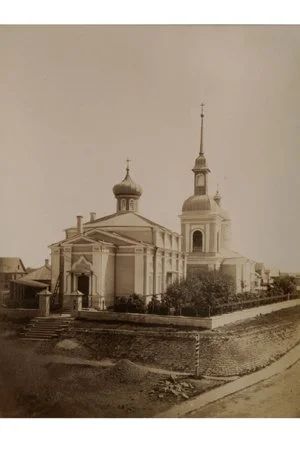
Church of St Nicholas in front, Church of the Sign at back
In 1854 (or 1855, according to some sources), a new brick church was built alongside and for the church of the Sign (built at the end of the eighteenth century) in Ivangorod. Made of brick, the church was a compact building, its rectangular centre topped by a small onion-domed tower. It was reminiscent of medieval Russian churches, but without a bell tower and with certain classical elements. The new temple was constructed as a warm building for the winter, as the church of the Sign had no stove until 1895. It was blessed in the name of St Nicholas the Miracle Worker. Earlier in this place there had been a wooden church of the Nativity of Christ, built in 1733 for soldiers quartered in Narva. However, in 1851 this church was torn down due to dilapidation: as is the Orthodox custom, the altar was burnt and the ashes thrown in the river [1]. The new church in Ivangorod was built with money from Pavel Orlov, merchant and elder at the church of the Sign. On 6 June 1852, Khristofor (Emmauskii-Lopatinskii), the bishop of Tallinn, personally laid the foundation stone of the new church [2].
With the development of industry in Narva from the 1860s and 70s onwards, an ever-increasing flood of settlers from Estland and Livland provinces arrived in the city looking for work. Among them were many Orthodox Estonians who neither understood Russian nor Old Church Slavonic, the language of the liturgy. To try and provide for the spiritual needs of these workers, the church of St Nicholas was presented to them, with the first Estonian liturgies performed there in the 1880s [3]. The person responsible for this was Father Petr Preobrazhenskii, who knew both Estonian and Finnish. As a travelling missionary, Preobrazhenskii served the religious needs of Russians and Estonians not only in Narva, but across the entirety of St Petersburg diocese [4]. In 1889, the Estonian parish of St Nicholas was formed as a separate entity from the parish of the Sign [5]. Services in Estonian were held not only in this Ivangorod church, however. In the late 1890s, Bishop Agafangel (Preobrazhenskii) of Riga also allowed Estonian liturgies to be held after Russian ones in the Kreenholm factory parish of the Resurrection [6]. The Kreenholm parish was mixed, consisting of both Estonians and Russians, although the number of the former was not great. Liturgies in Estonian were held in the factory church right up until the First World War.
The parishioners of the Ivangorod church of St Nicholas were Estonians living in Narva, Kingisepp (formerly Iamburg), and their environs. Covering such a large territory, the parish was initially quite large: according to statistics from 1901, the parishioners numbered approximately 1,000 [7]. In 1903, the Estonian congregation rented out the building of St Nicholas and all its property from the parish of the Sign [8]. This agreement left the church of St Nicholas as property of the parish of the Sign, later a cause of conflict between the two communities.
In 1903, Father Konstantin Kolchin, a native of Narva, was appointed as the priest of the Estonian parish, a position he held until the end of 1918. In 1919, he became the rector of the church of the Sign following the murder of Archpriest Dmitrii Chistoserdov at the hands of the communists [9]. While Kolchin continued to supervise the Estonian parish, he was busy with the larger Russian congregation and thus was unable to pay sufficient attention to his Estonian flock. Left without a pastor during war time, the Estonian parish began to fall apart. During the fighting around Narva, the church of St Nicholas was damaged, with the windows smashed and the roof wrecked: the building was left in this state for several years [10]. With the Treaty of Tartu in 1920 between the Estonian republic and the Soviet Union, the new border placed Narva-Ivangorod in Estonia: most of the parish of St Nicholas was thus left in Soviet Russia. From 1918 to April 1924, the Estonian parish of St Nicholas as an independent organisation did not exist, although Estonian liturgies continued to be held in the church [11].
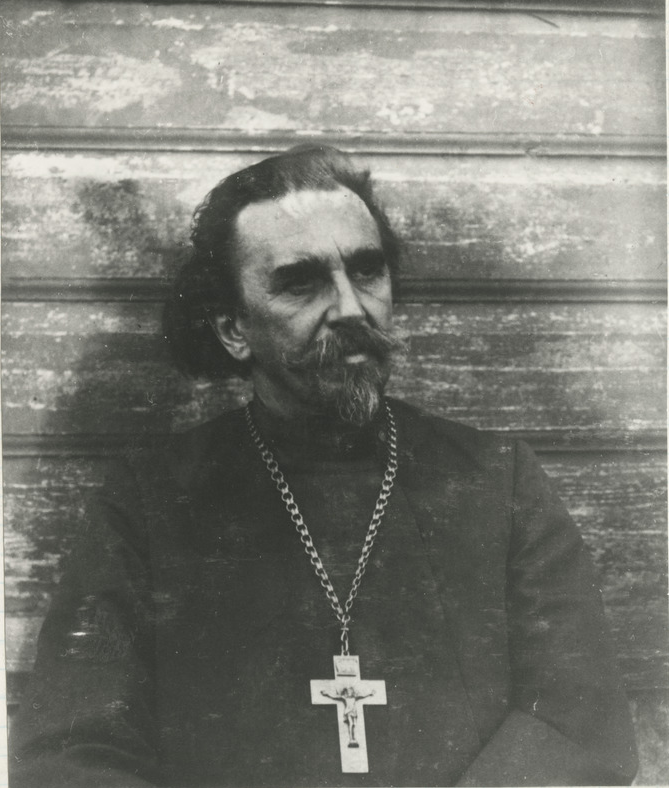
Archpriest Konstantin Kolchin, 1928 (EAA.5410.1.51.4)
1924 proved a turning point: a new parish council and a new priest, Father Sergei Samon, made ever more active attempts to restore the independent parish. The Synod of the Estonian Apostolic Orthodox Church (EAOC) quickly provided support. However, significant difficulties were soon encountered. As it emerged, the church of St Nicholas, rented by the Estonian parish from 1903, had returned to the church of the Sign along with Father Kolchin in 1919. The parish of the Sign had also taken possession of St Nicholas’ moveable property: this included vestments, liturgical books, parish registries, the church archive, and other bureaucratic documentation. It was impossible to compose a list of this property, since the necessary inventories had been lost [12]. Now began a long and difficult struggle to have the church returned. The Synod promulgated an edict on 17 April 1924 ordering Kolchin, then serving as the dean of the Viru region, to return the church of St Nicholas to the Estonian community, along with its moveable property and archive [13]. The Estonian congregation demanded that the Synod’s instruction be obeyed and rebuked Kolchin for intentionally drawing out the transfer [14], but the Russian parish did not respond, arguing they had no knowledge of any such order. This became the subject of long arguments between the two parishes. Holding a parish assembly on 8 February 1925 [15], the Russian community came to the conclusion that Kolchin was obliged to immediately return only the parish registries and seal to the Estonian group: the church of St Nicholas could only be transferred to the Estonian congregation at the voluntary will of its owner, the parish of the Sign [16]. Furthermore, the assembly believed that the 1903 contract had been violated and thus proposed putting together a new agreement. Negotiations were set for 13 February to discuss this new contract and sign it: however, the representatives of the Estonian parish council failed to appear [17].
As became clear, this was no accident: the Estonian parish council had a diametrically opposed view on the situation. In their opinion, the 1903 contract could not be voided until it was recognised by the new church authorities in Estonia, namely the EAOC and its Synod [18]. Besides this, the St Nicholas’ parish council thought the proposed new contract was unacceptable. Indeed, some of its clauses were even considered humiliating: the contract forbade the Estonian parish from holding liturgies in any language other than Estonian and from opening the church gates at any time other than during the liturgy while also demanding immediate repairs to the church building once the Estonian group took possession. Nothing was said about the return of church valuables [19]. However, these offensive clauses are in fact absent from the various drafts of the contract – it is quite possible that these heated matters were discussed during parish assemblies but did not make it into the drafts and final text. In terms of repairing the church, clause 12 stated the following: ‘The Estonian parish can take on exterior and future interior repairs to the church of St Nicholas as needed and when possible’ [20].
The negotiations were deadlocked. Polemics between the two sides appeared in the press, although on the pages of Byloi Narvskii listok the conflict did not seem irresolvable. The parish of the Sign communicated that it welcomed the restoration of the St Nicholas parish, claiming that it had never opposed this and would not do so in the future. The Estonian parish, for its part, stated that it did not seek ownership of the church: they only asserted that the transfer of the church had become convoluted and delayed.
For all the polemics, a contract was confirmed by both sides on 15 March 1925 [21]: following some edits by the Synod, it was finally signed on 24 September 1925 [22]. An additional act was signed a few days later agreeing to the transfer of silver-framed icons to the Estonian parish. Thus, the transfer of the church and its property took more than a year [23].
However, the new contract did not fully satisfy the Estonian parishioners. First, they wanted their independent parish to have its own church, not one rented from another congregation. Second, the church’s location was undesirable due to its distance from the city centre: it was located in Ivangorod, on the other side of the river. Travelling there from Narva was a long trip and required parishioners to climb a hill. Third, the repairs would cost large amounts of money that the Estonian parish did not have.
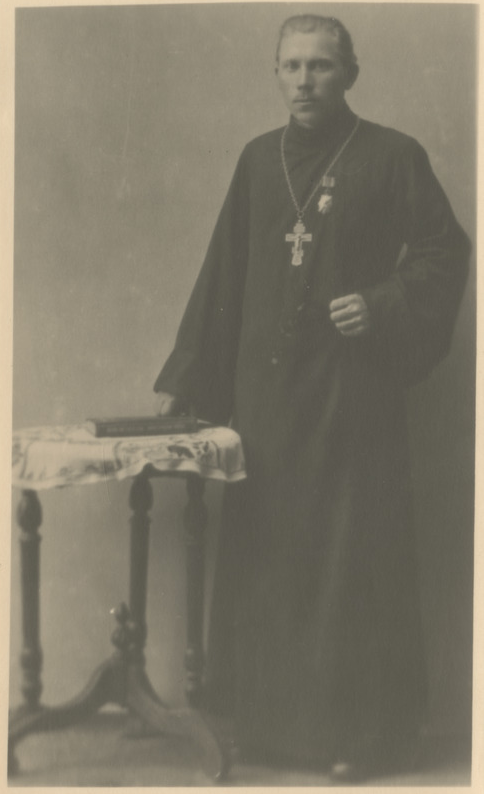
Father Sergei Samon (1902-1993), interwar period (EAA.5410.1.67.29)
For the moment, though, the Estonian parish was able to reopen in the rented church. The first pastor was Father Sergei Samon, who served from 1924 to 1928: he managed to revive the parish and laid the foundations for all its subsequent activities. In March 1925, he established a women’s committee. This organisation distributed aid to poor parishioners, undertook various charitable activities, provided material support to the church choir, maintained the clergy’s vestments, and kept the church and its property clean and orderly. On 13 December, the women’s committee held an exhibition sale that brough in a net income of 54,000 marks [24].
The celebration of Easter in 1925 was a great event for the parish. On the second day, Archpriest Dionissi Samon, secretary of the Synod, arrived in Narva to perform the liturgy together with Father Sergei (his son) and the deacon Augustin Pikkat. At the end of the service, he awarded active parishioners (such as the parish chair and the head of women’s committee) with marks of distinction issued by the Synod. Archpriest Dionissi also inspected one of the churches belonging to Narva’s cathedral of the Transfiguration – this, in the parish council’s opinion, would be a better home for the Estonian congregation than the church they currently rented from the parish of the Sign [25].
On the second day of Christmas 1925, the parish marked its first anniversary since its restoration. No little had been achieved: the parish had its own energetic and much-admired priest and a parish council of 12 members; a choir had been formed that not only sang in their church but also performed outside the city; both a women’s committee and a youth association (Lootus) had been founded, the latter of which had organised a library. On the next day, the youth association held a Christmas party for children and a celebratory dinner for parishioners in a local school. Father Samon gave a speech, after which the children’s choir performed various religious and secular pieces. The youth present then staged a play. At the end of the evening, the women’s committee handed out presents to children [26].
But what the parish lacked most of all was its own church. It was thus decided to quickly start gathering money for this goal [27]. The first attempt to build a church took place in 1926. The parish council submitted a blueprint to the Tallinn Diocesan Council, which was approved [28]. It was proposed to build the new church in the Joaoru (Joachimsthal) district, with its façade facing the River Narva. For this purpose, the parish acquired a plot of land and the walls of a ruined house. The total costs were estimated at 80,000 marks. The diocesan authorities permitted the parish to gather funds for the church in Estonia and Finland [29]. However, these plans were never realised. The Estonian parish was mostly made up of workers in Narva factories and peasants from surrounding villages, and as such was not wealthy: it could not afford to build its own church.
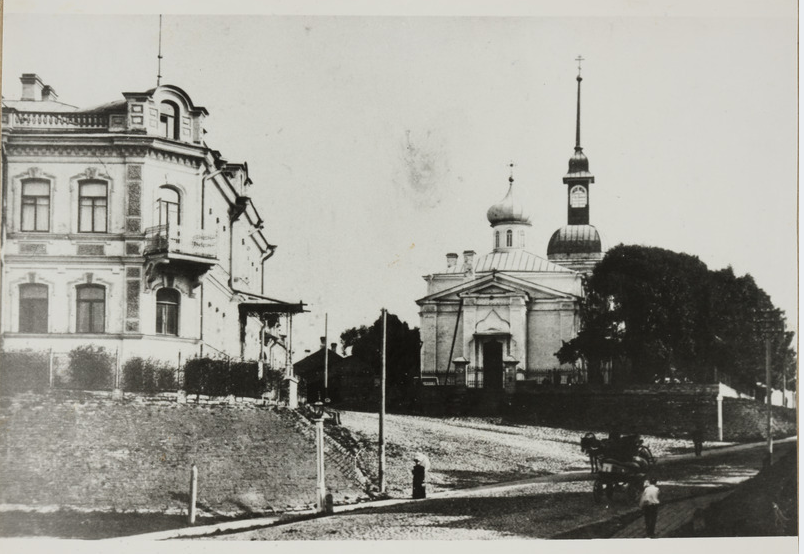
Narva-Ivangorod church of St Nicholas, interwar period (EAA.5466.1.21.31)
At the same time, the parish asked the cathedral of Transfiguration to provide them with one of its smaller attached churches. This it did at the recommendation of the council of Narva’s Russian parishes on 30 June 1926 [30]. The main reason for the transfer was a financial problem: it was time for the Estonian parish to repair its church in Ivangorod, but it had no money available. Building of a new church demanded large amounts of funds: paying for repairs to their current church (which the Estonian parish was obliged to do under their contract with the parish of the Sign) would only deepen their financial woes. It of no small importance that the cathedral’s attached church was in the centre of Narva and had been recently repaired. However, the cathedral’s parish assembly rejected the proposal [31].
From the very beginning of its existence, the Estonian parish of Narva and its clergy had devoted their energies to missionary activities, with travelling priest-missionaries performing services in distant regions with Estonian populations. Father Samon also sought to take under his wing Orthodox Izhorians in Russian settlements near the border with the Soviet Union. Due to a lack of Estonian-speaking clergy, the Izhorians were compelled to pray in Russian churches. The first such trip was held on 26 September 1926 to the village of Elkino: Samon, the parish council, and the church choir went to visit. This hamlet was located around 23 kilometres east of Narva. Reachable by motorboat via the Rivers Narva and Rossoni, this village was divided by the barbed wire fence of the border: part of it was in Soviet Russia, while the larger half was in Estonia. Samon’s liturgy was held in the open air in front of a small chapel beside the border: an unusually large number of people on both sides of the fence gathered. A rare scene of unity occurred, with villagers from both parts of the settlement gathering together to pray. The reception was very hospitable, with all the guests from Narva treated to dinner [32]. Father Samon began to travel to this village once a month. The Association for the Borderlands provided a monthly subsidy to the parish of 80 crowns for this work.
However, financial problems arose. Trips to the borderland Russo-Izhorian villages became impossible due to the unbearable expenses they imposed on the impoverished Estonian parish of Narva. With the departure of Father Samon from Narva in 1928, financial support from the Borderland Association ceased. On 18 May 1931, the parish appealed to the board of this association with a request to renew its assistance for this charitable aim, emphasising that Orthodox Estonians were pained to see how the Izhorians were being subjected to russification within the Estonian state [33]. In 1935, the access of Izhorians to the Orthodox liturgy was eased when one of their own, Father Mihkel Raud, was appointed to serve in the village of Veneküla [34].
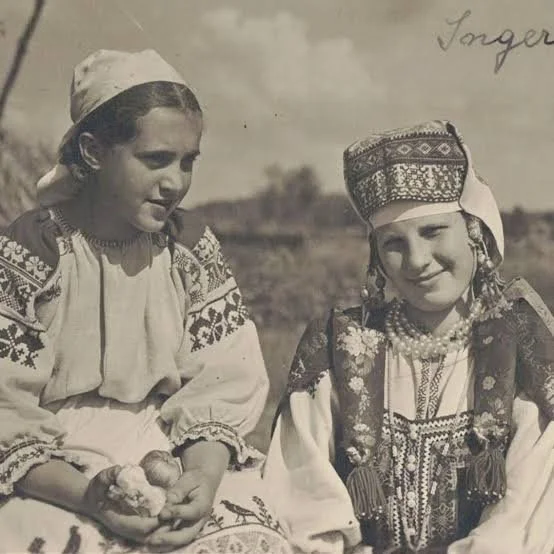
Izhorian girls in native dress (date and provenance unknown)
By 1926, the Estonian parish had managed to do much. The church’s roster of clergy included a priest, a deacon, and a choirmaster. Financial matters had somewhat eased, thanks to which it was possible to support a choir of 25 singers to the tune of 3,500 marks a month. The women’s committee and the youth association continued to work energetically. The women’s committee made money principally through organising and holding lotteries, as did the youth association, which planned such an event in the autumn of 1927 to support and fill a library. In the same year, the parishioners repaired the church’s exterior and interior at a cost of 60,000 marks [35].
By 1927, the number of parishioners was approximately 1,000. However, this number is open to question, as it is contradicted by other information. In a list composed by Father Samon, a total of 280 people was counted; according to Father Anton Angerjas, only around 200 people were full parish members: he had no information about the rest [36].
Typically, Orthodox Estonians in Narva were buried in the Ivangorod cemetery, although most of those laid to rest here were Russian Orthodox. But both Russian and Estonians tended to the graves. There was a tradition of holding a liturgy in Russian in the cemetery on the first or second day of the Trinity: the Estonians of St Nicholas’ also began to perform services there. In 1928, on the first day of the Trinity, Father Samon held a liturgy and a prayer service in the cemetery under the open sky, accompanied by the St Nicholas’ choir. Both Estonians and Russians prayed together [37]. This was but one of religious innovations of the Estonian parish. For instance, there was a custom among these parishioners of taking the sacraments and confession two or three times a year (rather than only once, as tradition dictated) [38].
In 1928, Father Samon received a new appointment elsewhere in the Viru region. The parishioners valued Samon most of all as a good preacher and organiser: the Russian Orthodox and Lutherans also respected him. He was well known as a social figure, being frequently invited to bless homes, open banks, and participate in various civil and military events: his speeches were everywhere met with great interest. On 30 September 1928, Samon held his last liturgy: the church was full. On the next day, 1 October, he left Narva for his new place of service. Almost all the parish gathered at the train station to see him off: the departing pastor was given expensive mementos [39].
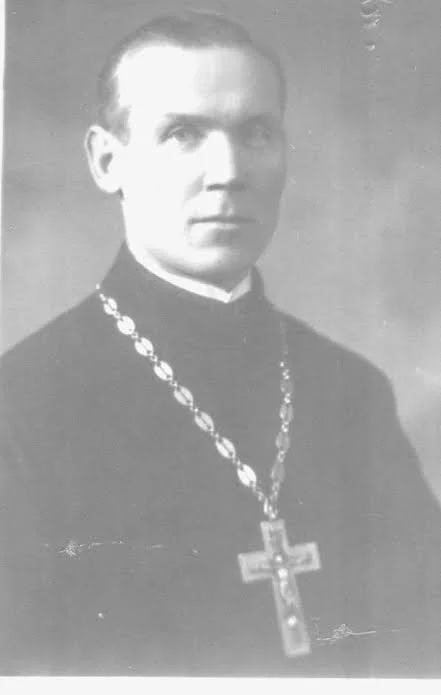
Father Anton Angerjas (1891-1964)
On 16 December 1928, a parish assembly was held to elect a new priest. Archpriest Georgi Andresson, the deputy dean of Viru, chaired the meeting and proposed electing Father Anton Angerjas, formerly of the Paldiski parish, to replace Father Samon. The parishioners liked Angerjas’ beautiful services and rich sermons. Therefore, his election was unanimous [40]. One of his first projects in 1929 was providing the church of St Nicholas with electric lighting, promoting the project among parishioners and asking for donations. On 12 April 1930, Palm Sunday, the church was suffused with electric light [41].
In 1931, one of the most important events in the parish was the wedding of Klaudia Pavel, chair of the women’s committee. She married Gustav Pranz, the assistant head of the Narva postal service. During the wedding, two choirs sang, the parish choir and the choir of a local association. There were so many people present that they could not all fit into the church. The wedding created a very good impression on all believers and was long the subject of discussion [42].
However, the fact that the parish lacked its very own church once again started causing issues. In 1932, the church of the Sign had to be closed for emergency repairs, which meant that its parish now had to come to the church of St Nicholas for services. The two communities were able to agree to the joint use of St Nicholas’, with Old Church Slavonic services being held on one Sunday and Estonian ones the next. However, disagreements arose over financial questions (keeping the church’s land in order, paying the wages of the doorman, and so on). The Estonians argued that so long as the parishioners of the church of the Sign used the church of St Nicholas, they should cover part of the expenses. The conflict was exacerbated by the fact that no clear deadline was in place for when the repairs to the church of the Sign would be completed: the Estonian congregation also had to delay repairs to the church of St Nicholas [43].
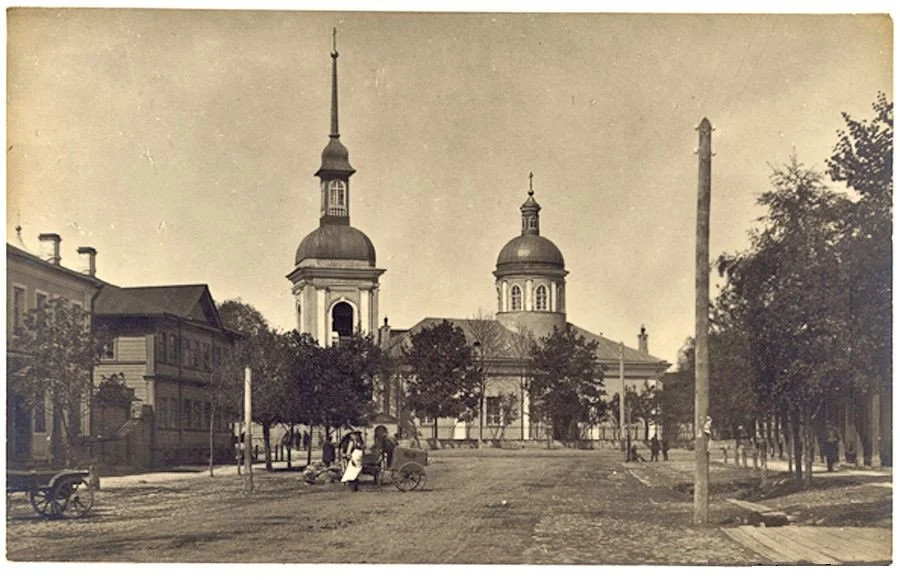
The Narva-Ivangorod church of the Sign, 1939
In 1934, Father Angerjas turned to the cathedral of the Transfiguration with a request to use its small attached church to celebrate Easter. However, he received a refusal: the cathedral wanted to celebrate Easter according to both the western and eastern paschalions, so the cathedral and its attached church were being used. On the threshold of this holiest of Christian holidays, the atmosphere in the Estonian parish was souring. Some parishioners began to exhibit a desire to seize control of St Nicholas to prevent the Russian parishioners of the Sign from entering. But Father Angerjas kept his congregation in line and refused to allow such outrageous behaviour. He communicated about the danger both personally to Metropolitan Aleksander and in writing to the Synod, asking for help: he hoped that the church authorities would ban all the city’s Russian parishes from holding Easter services according to both the western and eastern paschalions, thereby making the cathedral’s small attached church available to the Estonian parish for the Easter celebrations [44]. The question was thus solved and conflict avoided. On 7 November 1934, the church of the Sign was opened again [45], and the Estonian parishioners gradually calmed down.
Over the course of February, March, and April 1934, 60 Estonian citizens of Narva (17 men and 43 women) converted from Lutheranism to Orthodoxy, thereby increasing the numbers of the small Estonian parish [46]. Between 1934 and 1936, the parish grew from 452 to 478 parishioners.
The parish spent 1935 engaged in fruitful labour. Much effort was expended on opening a class of Orthodox religious instruction in Estonian for school pupils: 20 joined. A Sunday school was also established, although delays were encountered due to the lack of an appropriate building. Summer pilgrimages to the borderland Izhorian communities and the Baltic coast took place: the parish organised two trips to hold the liturgy in Kriushi (30 kilometres east of Narva) and another to Sillamae. For the parishioners of St Nicholas’ who lived in these settlements, too far from Narva to regularly attend church, it was undoubtedly very pleasant to hear Estonian liturgies, even if only once a year, in their home villages and near the graves of their relatives, where the clergy also performed requiem services.
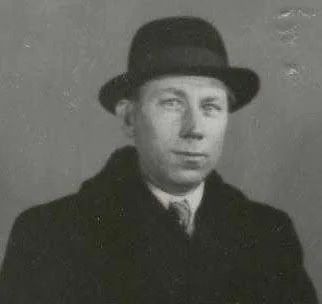
Father Mihhail Raud (1900-1983)
On 1 August 1937, Archpriest Anton Angerjas was transferred from Narva to serve as a priest in the Tallinn cathedral of St Alexander [47]. He was replaced by the Izhorian Father Mihkel Raud. By this point the parish had become a lively, independent community: its religious activities were successful and its financial position had been much strengthened. Acquiring property was again on the agenda. On 21 May 1939, the parish board discussed purchasing a large house with a loan: such a property would provide substantial income in the future [48]. On 23 October, the parish board asked the Synod for permission to receive a loan from a Narva bank to acquire a two-storey brick house valued at 10,000 crown in the city centre: it was proposed that this house would be used for religious and educational activities [49]. The parish board could cover the cost with the bank loan, some of which would be serviced with a state subsidy of 3,500 crowns issued to the parish as part of a package designed to aid Orthodox churches in Estonia’s borderlands [50].
However, the parish still lacked its own church. In the spring of 1939, there was hope that this situation might be rectified. At this time, Narva’s German Lutheran parish was closed due to the mass emigration of Estonia’s Germans to Germany. This parish’s place of worship was the church of St John: it had been built in the seventeenth century for the Swedish community and had served as the city’s cathedral until 1704. After Narva’s capture by the Russian army, it had been turned into an Orthodox church dedicated to St Aleksandr Nevskii. However, the church was soon closed in 1708: in 1733, it was given to the German Lutheran parish, which held it until 1939. It was now empty. Thus, on 22 October 1939, the parish board of St Nicholas’ asked the government to give the Estonian Orthodox community this church [51]. Several arguments were appended in favour of the transfer. The Ivangorod church of St Nicholas was located on Narva’s outskirts, making it difficult to reach; the Russian Orthodox parishes of the city owned more than one church each, but the Estonian parish lacked even one, despite having around 500 parishioners (a number that would doubtless increase if the parish was given a church in the town centre) [52]. However, the appeal was unsuccessful.
In February 1940, the parish finally had the opportunity to recover the property and archive it had lost in 1919. Under investigation for negligence, Archpriest Konstantin Kolchin of the parish of the Sign was ordered by the diocesan authorities to hand over all paperwork and property to his replacement, Father Mihkel Lukkanen. The Estonian parish decided to use this opportunity to try and regain its lost property. Although inventory documents were compiled [53], however, it is unknown whether the Estonian parish was successful in this matter.
In the midst of the Soviet invasion of 1940, Father Mihkel Raud requested retirement: Lukkanen was appointed as his replacement [54]. However, he served only until 1941, when he was conscripted into the Red Army [55]. The parishioners were thus left without a pastor and were soon also deprived of their church. Heavily damaged during the fighting in Narva, the church of the Sign was closed: its services were transferred to the church of St Nicholas [56]. Thus, Orthodox Estonians had to attend liturgies either at the Kreenholm church of the Resurrection or the Transfiguration cathedral, where services were held in Old Church Slavonic. Some went to Lutheran churches: even though the services were not Orthodox, they were at least held in their native language. According to Bishop Pavel (Dmitrovskii), ‘they are straying like sheep without a shepherd’. The long-suffering Estonian parish seemed like a ‘lesser son’ among the other Narva parishes.
In December 1941, Archpriest Aleksander Männik, the dean of the Viru region, appointed Archpriest Georgi Andresson of Kreenholm with stewardship over the Estonian parish [57]. Both the parish board and the diocesan authorities renewed their efforts to find a church. In a letter to Metropolitan Aleksander, Bishop Pavel proposed giving the Estonian parish the church of St Vladimir’s, which had been free following that parish’s amalgamation with the cathedral of the Transfiguration several years earlier [58]. Pavel was supported by Archpriest Andresson in these endeavours [59]. On 31 December 1941, Metropolitan Aleksander gave his resolution: ‘I recognise the transfer of the Narva church of St Vladimir and its parochial house to the Narva Estonian parish of St Nicholas as necessary and appropriate, and from my side I support this affair and give my blessing and permission’ [60]. But despite such highly placed support, the matter remained unresolved. On 19 May 1942, Father Mihkel Raud once again became the parish priest of St Nicholas’: Metropolitan Aleksander allowed the community to temporarily hold liturgies in the Kreenholm church of the Resurrection [61]. The first Estonian service was held in this church on 24 May 1942 and continued until 1944 [62].
The Second World War dealt the parish a blow from which it could not recover. In 1944, part of the church of St Nicholas was destroyed during fighting over the city: the damage was calculated at 498,771 roubles [63]. Most parishioners had resettled in other places, leaving no-one in place to attempt to restore the congregation, so it was finally closed in 1944. The ruins of St Nicholas’ were swept away in the 1950s.
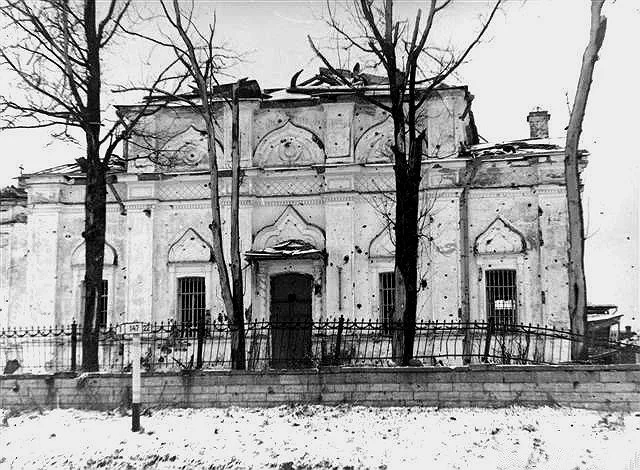
The ruins of the Narva-Ivangorod church of St Nicholas, 1944
The Estonian parish of St Nicholas in Narva was the only Estonian Orthodox congregation in all of the Viru region. Its parishioners lived across a large territory consisting of Narva and its environs. The parish was active in missionary matters, organising liturgies in Estonian for Orthodox Izhorians in surrounding villages. The lack of its own church building often affected parish life, but nonetheless the community was able to organise a considerable amount of religious and charitable work following the congregation’s resurrection in 1924. The Narva parish of St Nicholas left a distinct imprint on the city’s interwar religious life and assisted in spreading Orthodoxy in eastern Estonia.
Notes
[1] H. Hansen, Izvestiia o greko-rossiiskikh tserkviakh v gorode Narva (1861). Manuscript. Narva museum, d. 1775/1.
[2] H. Hansen, Geschichte der Stadt Narva (Dorpat, 1858): II: 351-354.
[3] V. Berens, Prikhody g. Narvy. 1974. Manuscript in the Estonian Historical Archive (EAA).
[4] Staryi Narvskii listok. 1930. No. 134.
[5] Ibid. However, the Estonian parish was only officially recognised in 1895.
[6] Uus Elu. 1925. No. 5. 12.
[7] Uus Elu. 1930. No. 4. 11.
[8] Byloi Narvskii listok. 1925. No. 10.
[9] EAA.1655.3.543.19.
[10] Uus Elu. 1930. No. 4. 11-12.
[11] Byloi Narvskii listok. 1925. No. 23.
[12] EAA.1655.3.543.19.
[13] Byloi Narvskii listok. 1925. No. 27.
[14] Ibid.
[15] Byloi Narvskii listok. 1925. No. 23.
[16] Byloi Narvskii listok. 1925. No. 23.
[17] Ibid.
[18] Byloi Narvskii listok. 1925. No. 27.
[19] Byloi Narvskii listok. 1925. No. 19.
[20] EAA.1655.3.543.143-145.
[21] Byloi Narvskii listok. 1925. No. 35.
[22] EAA.1655.3.543.1.
[23] EAA.1655.3.543.138-140.
[24] Uus Elu. 1926. No. 3-4. 15.
[25] Uus Elu. 1925. No. 5. 12.
[26] Uus Elu. 1926. No. 1. 11.
[27] Uus Elu. 1926. No. 2. 10-11.
[28] EAA.1655.3.543.121-123.
[29] Staryi Narvskii listok. 1926. No. 23.
[30] Uus Elu. 1926. No. 7-9. 15.
[31] Staryi Narvskii listok. 1926. No. 112.
[32] Uus Elu. 1926. No. 11-12. 12-13.
[33] Narva Õigeusu Eesti koguduse preester Piirimaade Seltsile, 1931. Kirjandusmuuseum, f. 235.
[34] Elutõde. 1936. No. 6. 10.
[35] Uus Elu. 1927. No. 11-12. 14.
[36] Uus Elu. 1930. No. 4. 11-2.
[37] Uus Elu. 1928. No. 6. 7.
[38] Usk ja Elu. 1935. No. 3. 49.
[39] Uus Elu. 1929. No. 1. 6-7.
[40] Uus Elu. 1929. No. 2. 7.
[41] Uus Elu. 1930. No. 9-10. 10.
[42] Uus Elu. 1932. No. 2. 6.
[43] EAA.1655.3.543.93.
[44] EAA.1655.3.543.79; 93.
[45] Staryi Narvskii listok. 1934. No. 130.
[46] Pravoslavnyi sobesednik. 1934. No. 1. 73.
[47] Staryi Narvskii listok. 1937. No. 92.
[48] EAA.1655.3.543.23.
[49] Ibid.
[50] Ibid. 26-27.
[51] Ibid. 29.
[52] Ibid. 28.
[53] Ibid. 19.
[54] Ibid. 16.
[55] Ibid. 10
[56] Ibid.
[57] Ibid., 13-15.
[58] Ibid., 10.
[59] Ibid., 14.
[60] Ibid., 8.
[61] Ibid., 3.
[62] Ibid. 4.
[63] TLA. Akt sõjategevuse tagajärel tekkinud kahjude kohta. Tallinn, 1945.
Author
Galina Siniakova
Translator and editor
James M. White
Original publication
G. Siniakova, ‘Narvskii estonskii pravoslavnyi Nikolaevskii prikhod’, Sbornik Narvskogo muzeia (2000): 66-95
Date Added
23 November 2026