Archpriest Vassili Russ/Tammistu (1873 – 1955)
Priest as Administrator, Teacher, and Social Leader
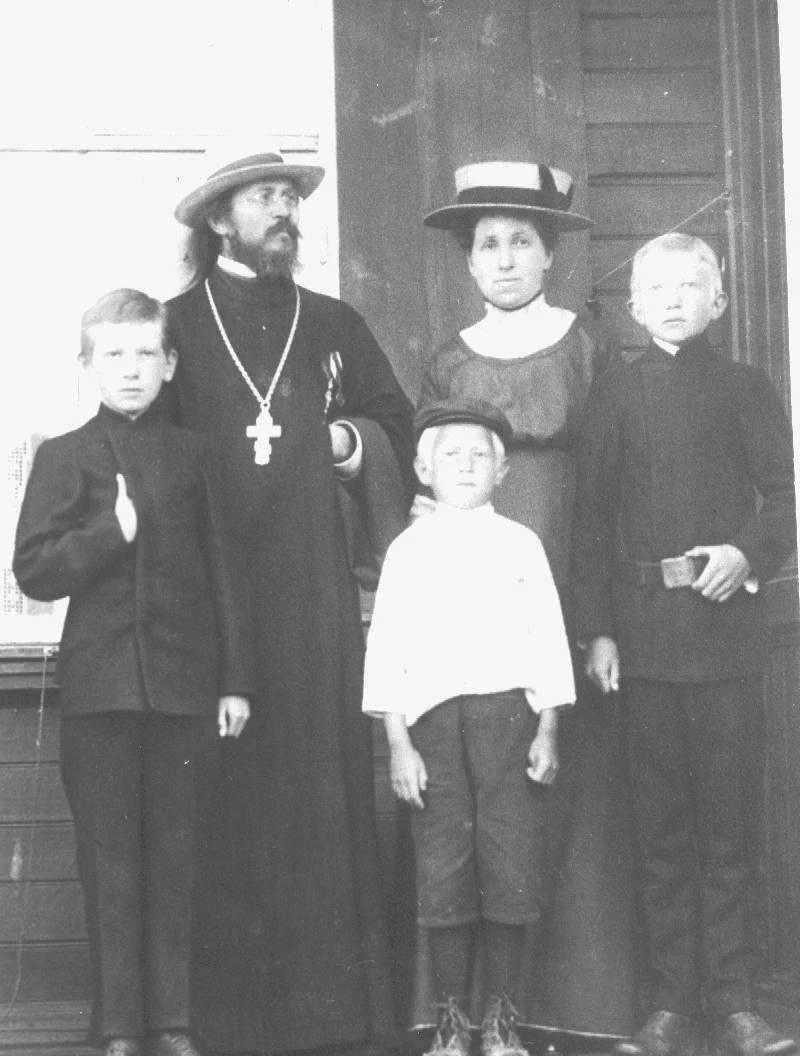
Father Vassili Russ, his wife Anna, and three of their sons
Archpriest Vassili Russ’ nearly six decades of church and educational work on the island of Saaremaa spanned very different eras: the final decades of the Russian Empire, the Republic of Estonia, the Second World War, and the Soviet period. His ministry encompassed school work, the establishment of a new parish, financial and administrative affairs, and relations with sacristans, teachers, parishioners, and the church leadership.
Russ was born on 7 October 1873 in Maasi village on the island of Saaremaa, into the family of the farmer Konstantin Russ. He received his primary education at the Ööriku Orthodox parish school. He then went on to study at the Riga ecclesiastical school and seminary from 1886 to 1895: he qualified as a sacristan and schoolteacher in 1896 and was assigned to the Nursi auxiliary school. Russ was to spend the next decade and a half working as a teacher in a variety of both church and secular schools spread across the northern Baltic provinces.
In 1899, the young teacher married Anna Muhina (1876), with whom he had three children: Nikolai (1900), Peeter (1902) and Antoniina (Leini, 1915). The family also included two foster children, Konstantin and Boris. During the early years of the marriage, the Russ family lived in Kahtla, but later moved to Torgu. The eldest son, Nikolai, worked as a parish clerk: at the start of the Soviet occupation, he and his family were deported to Russia, where he died. Peeter trained as a schoolteacher and worked in Kaarma. Boris graduated from the Kuressaare Maritime School, completed his military service in the Estonian Defence Forces, and subsequently worked as a ship’s mate. Antoniina Russ (later Rander) graduated from grammar school in 1935 and qualified as a primary school teacher. She worked as a teacher in Mustjala and Kuressaare. In 1950, she was dismissed from her post because she was the child of a clergyman. After leaving teaching, she worked in retail, and later taught Russian at the Kuressaare primary school. She married three times: first to Josua Köster, the parish clerk of Torgu; then to Arved Johanson; and finally to Eduard Rander. Her son, Tiit Köster, became head of the Kuressaare Music School, while her daughters, Tiiu Johanson and Anna Rander, trained as a doctor and a designer, respectively. Antoniina’s memoirs provide a glimpse into the Russ family’s life on Saaremaa and their involvement in promoting local educational and cultural life. She remembered her father as an active community figure.
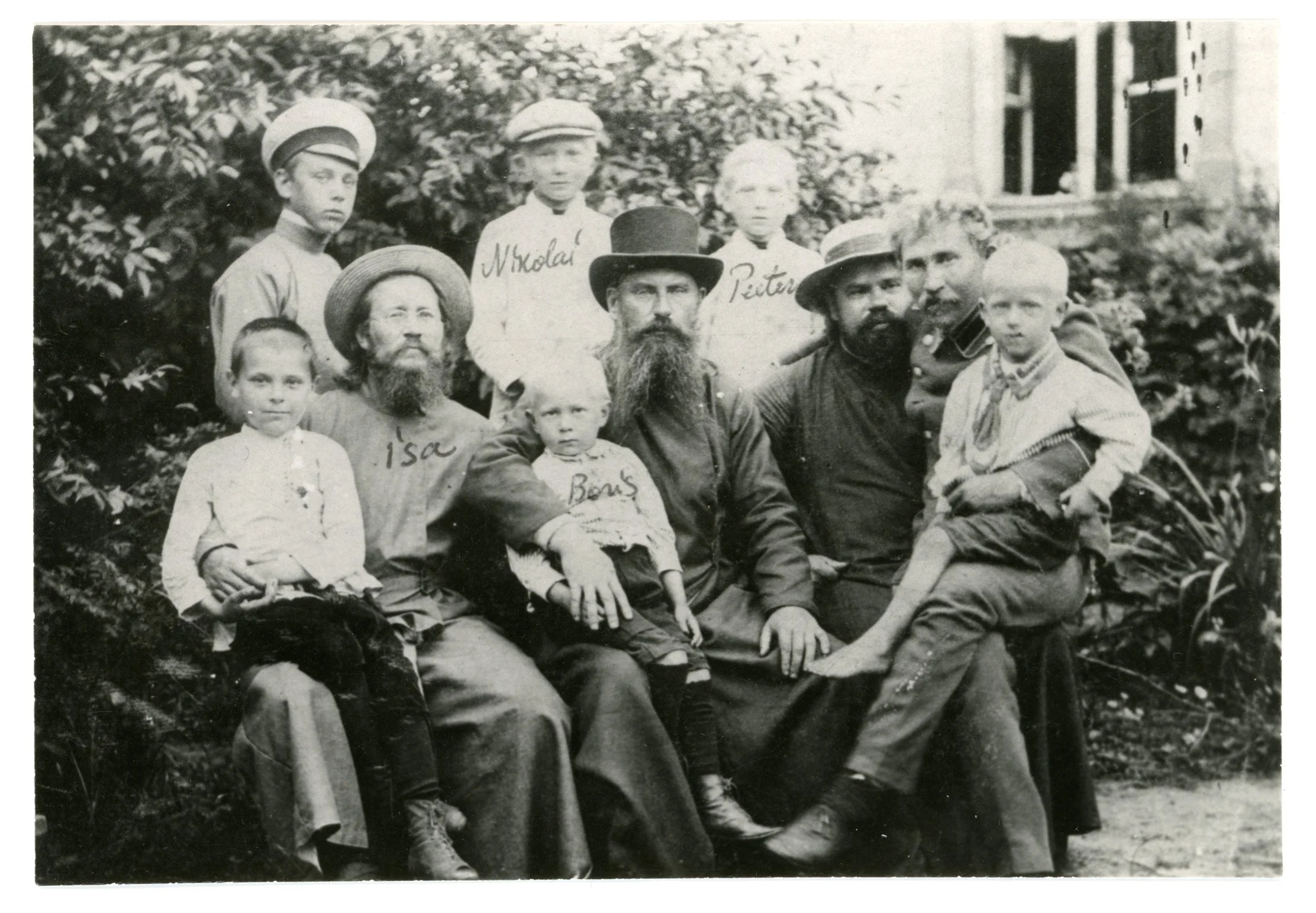
Father Vassili Russ with friends and family (Russ sits furthest to the left)
On 11-13 September 1911, Archbishop Ioann (Smirnov) of Riga ordained Vassili Russ as a deacon and a priest. He was appointed as the first priest of the newly established parish of St Aleksandr Nevskii in Levala. This parish was formed on 11 September 1910 from the Ööriku, Tornimäe, and Laimjala parishes. When Russ performed his first service on in Levala on 23 October 1911, the parish did not have a church building: instead, services were held at the farmstead of the widow Melania Reis, where part of the barn had been converted into a temporary church. As of 1911, the congregation had 1,356 members. According to the church chronicle, during Father Russ’s tenure, attention was paid to establishing the congregation’s material resources. Initially, icons and liturgical items were borrowed from neighbouring parishes. In 1912, the parish acquired liturgical books, priestly vestments, communion utensils, and other items from the Holy Synod, the chief organ of the imperial Russian Orthodox Church. At Russ’ request, the Baltic Orthodox Brotherhood, a leading religious charitable organisation in the region, donated a chandelier, three church bells, a communion set, and priestly vestments.
Russ’ arrival in Levala marked the beginning of a period when the young priest wasinvolved in long-lasting conflicts with junior clergymen. The Levala church chronicle provides a detailed account – though predominantly from Russ’ own perspective – of his relations with the parish sexton, Julian Peterson. In Russ’ view, Peterson did not devote sufficient attention to his duties as a sacristan, as he was worked simultaneously as secretary of the Pöide Consumers’ Cooperative. Furthermore, Russ also criticised Peterson’s command of Church Slavonic. Following intervention by the church authorities, Peterson gave up his secondary employment, but his relationship with the priest did not improve: so, Peterson was transferred to the Lihula parish from 12 November 1912. At this point, the conflict between Russ and Peterson’s wife - whoremained in Levala - escalated. Russ requested that an investigation be launched into her conduct. However, his immediate superior Father Joann Elend, the dean of Saaremaa, viewed the allegations critically: in his view, Russ’ complaint stemmed from his excessive pedantry and lack of tact in his dealings with subordinates. Russ did not agree and in turn criticised the dean’s conduct, noting that Elend’s duty should have been to protect the reputation of the deanery and to support an objective resolution of the conflict. ‘So this is what faith in those in power amounts to!’, Russ bitterly lamented. However, the conflict does not seem to have affected Russ’ reputation or career prospects: on 24 May 1913, he was promoted to the larger parish of St Basil the Great in Laimjala.
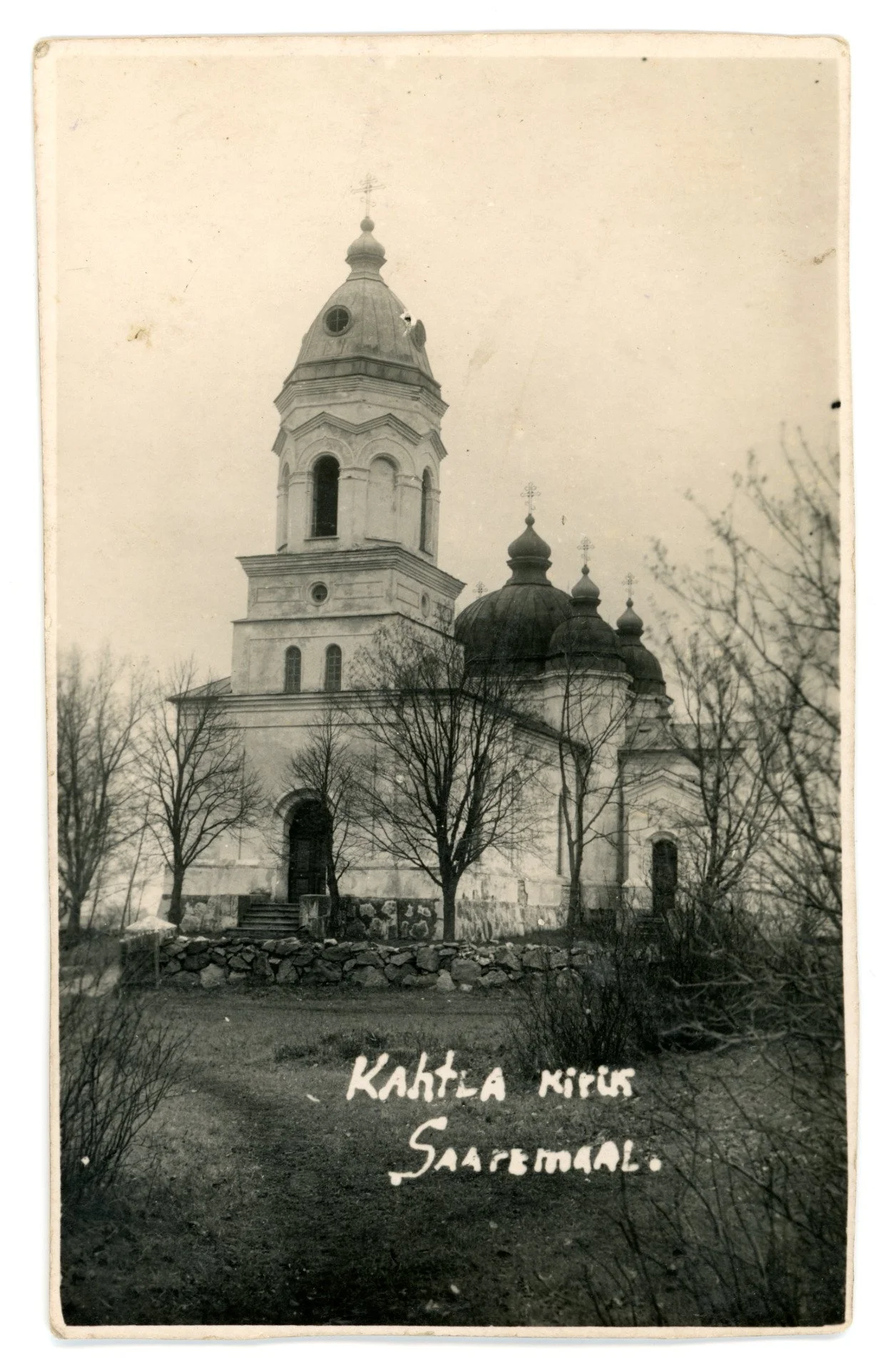
Laimjala Orthodox church of St Basil the Great
But here, too, relations with other members of the clergy were strained. On 2 February 1915, 169 members of the Laimjala parish submitted a collective complaint to Archbishop Ioann, in which they accused Russ of self-interest and poor relations with the parish: they requested his replacement. The priest and his backers responded the complaint did not reflect the views of the majority of the congregation. Russ attributed the opposition primarily to the actions of the sacristan Kirill Umal and and his wife Elena. Dean Elend was suspicious, noting to the archbishop that Russ had a prior track of record of conflict. Thus, on 8 May 1915, Archbishop Ioann decided to launch an official inquiry: 143 individuals in total were interviewed. Their statements revealed that the complainants’ motives were not uniform. Some made specific allegations, but many admitted that they had not familiarised themselves with the contents of the initial complaint (written in Russian) or had signed it primarily out of a desire to have a second priest in the parish. Russ, for his part, rejected the allegations: among other things, he denied having misappropriated the parish school’s inventory and unlawfully withholding teachers’ salaries. Russ also argued that the investigation damaged his reputation while failing to clarify the complainants’ actual motives.
With the investigation’s findings presented on 3 May 1916, it took the consistory more than a year to reach the conclusion that the allegations set out in the complaint were not sufficiently substantiated. This did not satisfy Russ, however: he also sought to rehabilitate his reputation in the press. To this end, on 17 June 1917, he published an opinion piece in Päevaleht, in which he linked the tumult in his parish to the returning soldier Aleksander Reis (1866–1917), whom Russ regarded as a political agitator operating in the Laimjala parish. Allegedly, it was Reis and sacristan Kiriil Umal, who had launched a smear campaign against him: such was the extent of the animosity between Russ and sacristan Umal that the latter had submitted complaints to the consistory about the priest’s conduct at the end of 1916. Russ claimed that the real background to the conflict was an investigation into the use of funds at the Laimjala Orthodox parish school and library: the complaint against him had been lodged in order to derail this investigation. Ultimately, the Laimjala conflict was several intertwined disputes concerning personal relationships, the use of school and parish property, and the organisation of work for sextons and schoolteachers.
The longest and most peaceful period of Russ’ life spanned the years 1921–1940, when he was the rector of the parish in Torgu. As this was one of the smallest Orthodox parishes on Saaremaa (304 members as of 1932), Russ found it easy to combine pastoral work with the promotion of local schools and cultural life. In 1923, he was appointed as a teacher at the local upper primary school, and from 1926 to 1935 he served as headmaster of the primary school in Torgu-Iide, a small school with fewer than a hundred pupils. The school operated from the premises of the former Orthodox parish school and parish hall and was an important educational centre for the entire Sõrve region. In May 1939, the parish hall, together with the schoolrooms housed within it, was destroyed by fire. The school’s equipment, documentation, office, and library were lost in the blaze. Only the harmonium was saved. Russ believed that it was possible that the fire had been started deliberately.
During his time in Torgu, Russ was one of the central figures in local social and cultural life. He was a member of the executive committee of the Torgu Singing and Music Society, served as drama director in 1926, and was elected chairman in 1928. He took part in various activities organised by local associations and gave speeches on Mother’s Day, harvest festivals, and Republic Day celebrations. In 1938, prior to participating in the 11th National Song Festival, he organised the blessing of the society’s new flag. The priest also developed close ties with the Sääre sea rescue station, where the staff were predominantly Orthodox. On 25 November 1934, Russ blessed the presentation of an Estonian Red Cross medal to Laas Mündi, the station’s long-serving manager who had taken part in the rescue of more than a hundred people in distress at sea.
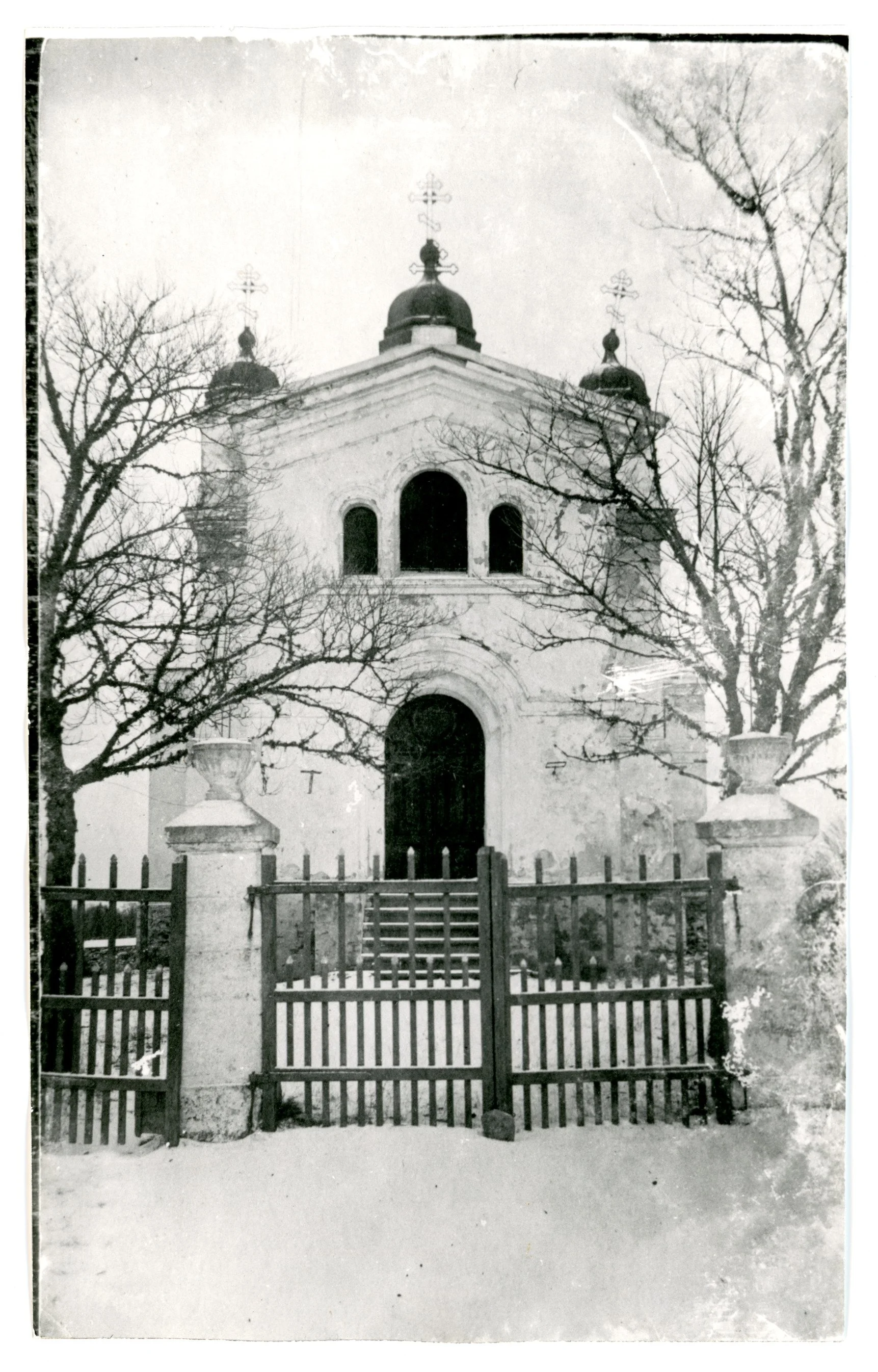
Torgu Orthodox church
A significant part of Russ’ activities involved participating in key events in local economic life. He consecrated new cooperative dairies and dairy plants and delivered speeches on current affairs. Particularly noteworthy among these was the opening of the Sõrve Dairy Association’s steam-powered production in 1927. These events clearly reflect rural society’s understanding of the role of the Church, according to which clergymen should bless all undertakings important to the community. However, such occasions could also cause reveal tensions in the relations between different denominations on Saareemaa. In 1927, Russ and Adalbert Hugo Willigerode, the pastor of the Jämaja Lutheran congregation, initially refused to take part in the consecration of the Kargi dairy, as the Methodist minister Karl Kuum had also been invited. However, Willigerode later changed his mind, arrived late and gave a short speech. Consequently, the only person who ultimately did not take part in the blessing was Russ, who had not been informed in time of Willigerode’s change of mind. The incident caused unease amongst local residents and demonstrated that, although there was day-to-day cooperation, relations between the denominations did not always run smoothly.
Thus, during his time in Torgu, Russ was able to make the fullest use of his experience as a clergyman, teacher, and community leader. Unlike his time in Levala and Laimjala, which were characterised by conflicts and investigations, his stay in Torgu was associated above all with the congregation’s integration into the active social life of the Sõrve community.
In 1940, Father Tammistu (as Russ was known from 1937) was appointed as the rector of the parish in Mustjala. During the Soviet occupation, both the priest himself and his daughter came under the scrutiny of the authorities and were required to attend regular interrogations. During the subsequent German occupation, the priest returned to church ministry, serving as senior priest in Mustjala from 1942 to 1945. On 19 October 1943, Metropolitan Alexander elevated Father to the rank of archpriest. After the Second World War, Tammistu served both in Reomäe and part-time in the St Nicholas parish in Kuressaare together with the priests Felix Kadarik and Andrei Klaas: Kadarik was primarily responsible for the Estonian-speaking parishioners, while Klaas and Tammistu ministered to the Russian-speaking congregation, which included the families of military personnel. However, the parish’s financial situation deteriorated and supporting three clergymen became a burden: Tammistu thus served the Kuressaare parish alone from 1952 until 1954. Ceding the position of rector to a successor, Tammistu continued to work as a sacristan in the church until his death on 3 April 1955.
Archpriest Vassili Russ/Tammistu’s life spans an exceptionally turbulent period in the history of the Estonian Orthodox Church. Incidents associated with him help to illustrate that, in the first half of the twentieth century, leading a parish involved not only organising church services but also constantly dealing with schools, staff, property, financial matters, and relations amongst parishioners.
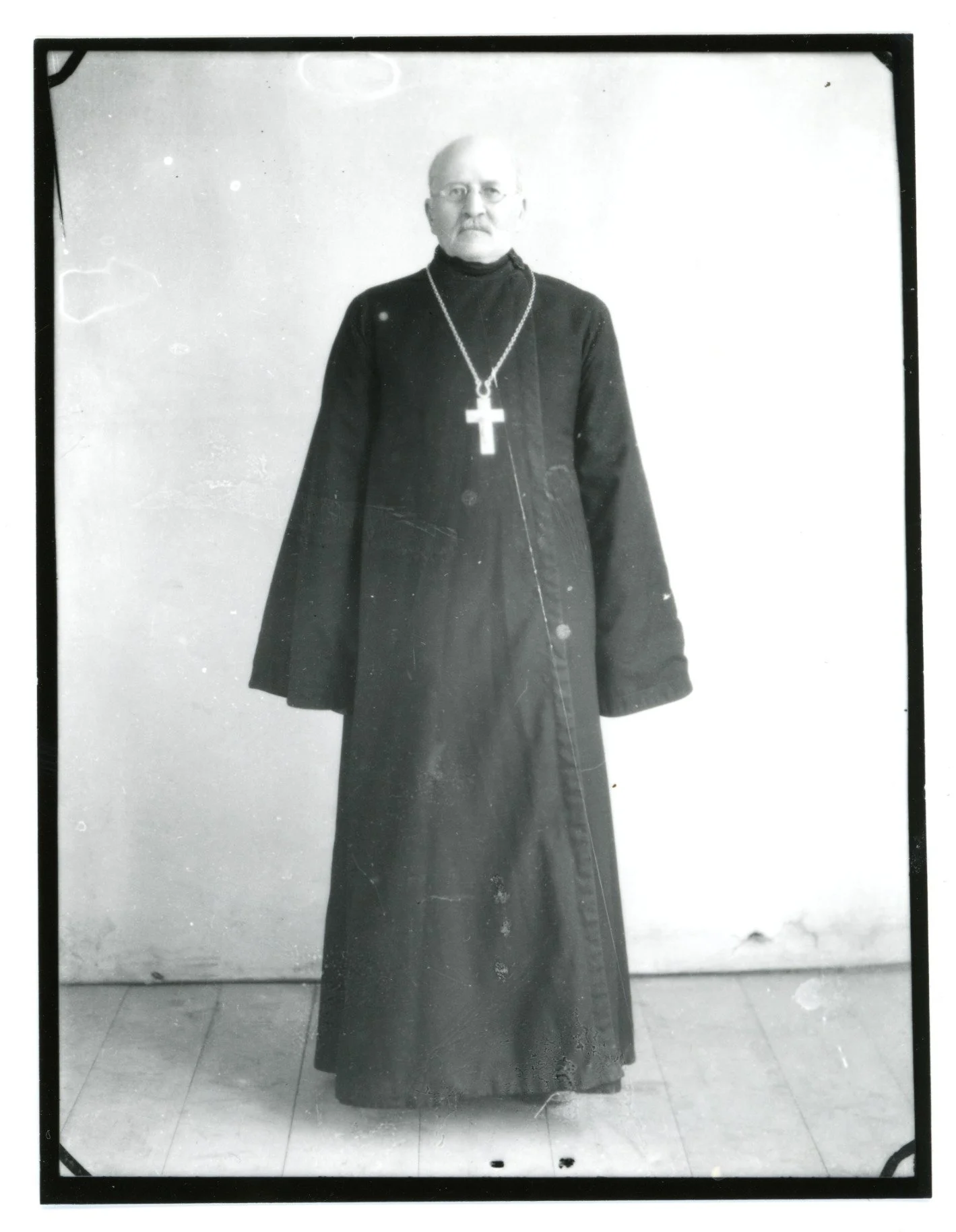
Archpriest Vassili Russ/Tammistu shortly after the Second World War
Sources
EAA.1655.2.III.4139
EAA.1655.2.4141
EAA.1655.3.150
EAA.5437.1.64
EAA.5410.1, lk 247–249
Lääne Teataja, nr 25, 23. september 1933, lk 2. Leidub netis
Põld Andreas. Ülempreester Vassili Tammistut meenutades. Meie Maa, nr. 268, 28 november 2013, lk 6. Leidub netis: https://dea.digar.ee/cgi-bin/dea?a=d&d=meiemaa20131128.2.9.3&e=-------et-25--1--txt-txIN%7ctxTI%7ctxAU%7ctxTA------------- (Vaadatud 10.8.2026)
Rander, Leini. ”Ma muudkui käisin ülekuulamisel…” Meie Maa, nr. 99, 27 mai 2000, lk 6. Leidub internetis: https://dea.digar.ee/?a=d&d=meiemaa20000527.2.18.1.1&srpos=8&e=-------et-25--1--txt-txIN%7ctxTI%7ctxAU%7ctxTA-preester+Vassili+Russ------------
Russ, Vassili. Laimjalast. Päewaleht, nr. 132, 17 juuni 1917. Lk 2. Leidub netis:
https://dea.digar.ee/cgi-bin/dea?a=d&d=paevalehtew19170617&e=-------et-25--1--txt-txIN%7ctxTI%7ctxAU%7ctxTA------------- (Vaadatud 17.8.2026)
Torgu-Iide ühiskool. Torgu Valla Leht, nr. 1, 1 jaanuar 2009, lk 2. Leidub internetis:
https://dea.digar.ee/cgi-bin/dea?a=d&d=torguvalla20090101.2.5&e=-------et-25--1--txt-txIN%7ctxTI%7ctxAU%7ctxTA------------- (Vaadatud 17.8.2026)
Рижские епархиальные ведомости, nr 22, 15. november 1912, lk 699. Leidub internetis https://pravoslavnoe-duhovenstvo.ru/media/priestdb/materialattachment/attachment/57/84/57841a28-90f3-4cca-9ba7-568bb228ab89.pdf (vaadatud 17.8.2026)
Raudsepp, Anu. Riia Vaimulik Seminar 1846–1918. Tartu, 1998, lk 141.
Sõtšov, Andrei. Eesti õigeusu piiskopkond Stalini ajal aastail 1945–1953. Tartu, 2004.
Toon, Martin. EAÕK Kuressaare Püha Nikolai koguduse ajalugu. Kuressaare, 1997, 43 – 44.
Author
Father Andrei Sõtšov
Date Published
26 October 2026