The Fake Metropolitan, 1926-27
Following the catastrophic First World War, the Baltic region was dotted with new states, borders, and Orthodox jurisdictions. Establishing mechanisms of control (like border guards, customs checks, and a functioning passport regime) over recently established boundaries was complicated by immense surges of people travelling in one direction or the other, often with nothing but the clothes on their backs. Flowing into the Baltics were not only Estonians and Latvians who had migrated into the former empire in search of work, but also Russians fleeing Bolshevik persecution and the vicious strife between the Whites and the Reds. A lack of proper identity papers was surely a minor issue compared to the disease, hunger, and distress disproportionately suffered by these refugees, but it could be a pressing one, denying them access to work, housing, and the opportunity to build their lives anew. Little wonder that we find instances of document forgery and people smuggling into the early 1920s, sometimes with the direct involvement of Orthodox clergy [1].
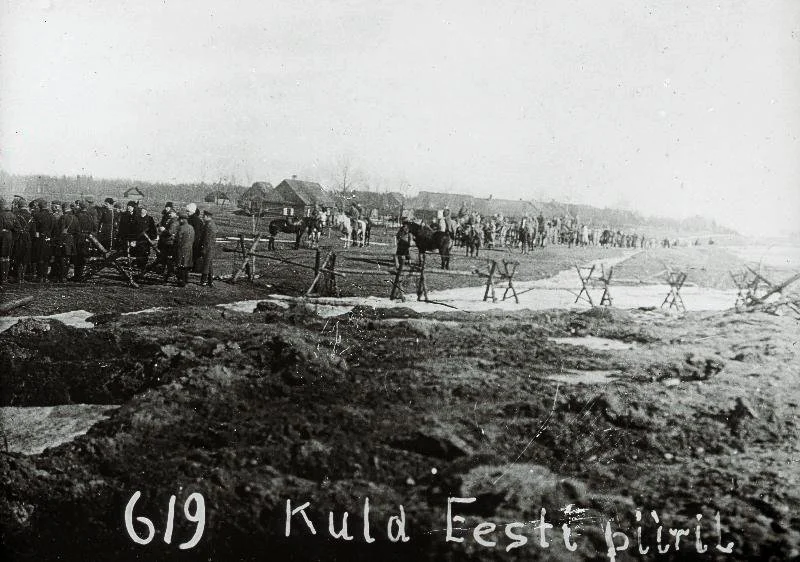
Estonian-Soviet border, 1920 (EFA.11.2.1630)
The Orthodox Church in the Baltic had parallel problems. Many of its institutions, a lot of its property, and a hefty proportion of its personnel were evacuated into Russia between 1915 and 1918, some of which never returned. In place of priests and sacristans at least somewhat rooted in the region were Russian émigrés, some of whom were politically suspect either as supporters of an indivisible Russian Empire or as potential Soviet agents. How could they prove that they were indeed men of the cloth, properly ordained into the apostolic succession? In the imperial epoch, the Russian Orthodox Church had maintained a system of service lists, records of the biographies, positions, family, and behaviour of clergymen: the originals of these lists were kept not by the priests themselves, but by the consistories, which were responsible for making any amendments and certifying them, rendering the lists official identity papers. However, the clergy who escaped Russia after 1917 often did so hurriedly, unable to get copies of their service lists before they ran.
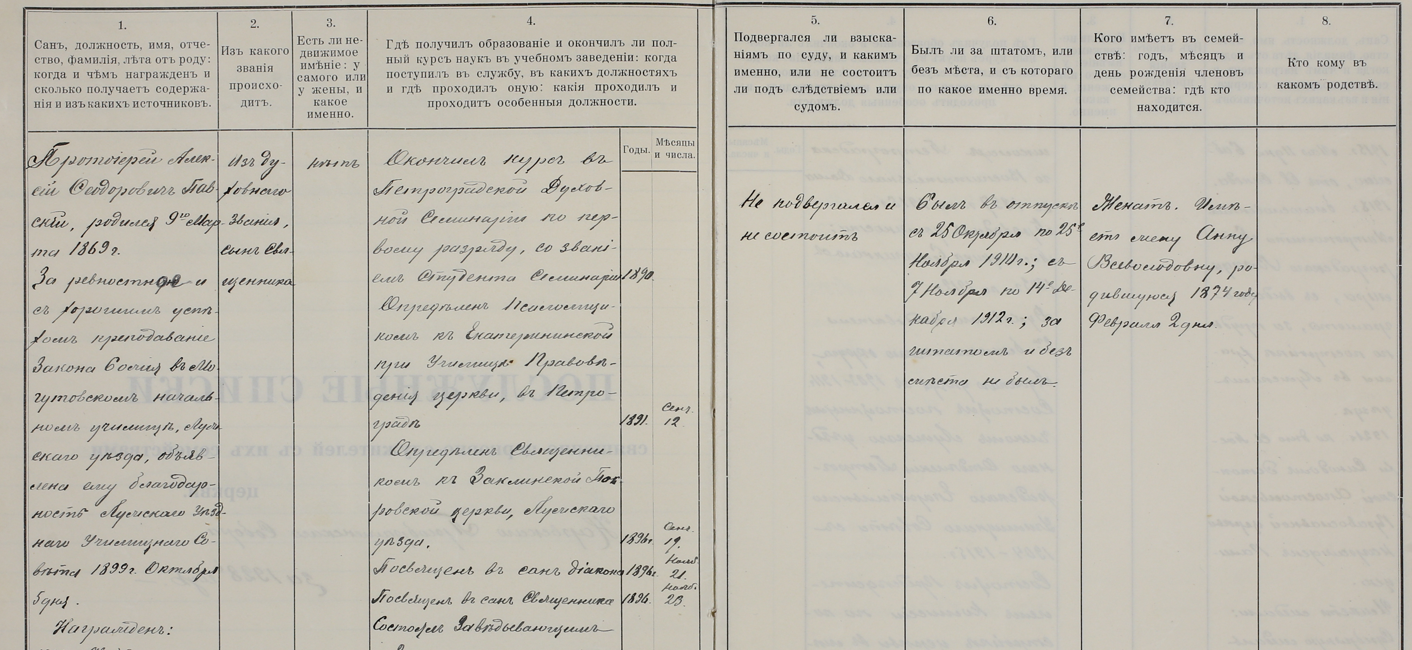
Clerical service list of Archpriest Aleksii Pavskii of the Narva cathedral of the Transfiguration for 1928 (EAA.1655.2.2706).
Unsurprisingly, personal networks of friends, colleagues, and acquaintances became important for confirming the self-authored CVs on which the refugee priests were forced to rely while they waited, in some cases fruitlessly, for papers to be sent from the Soviet Union. But such documents were invitations for fraud: at least two Orthodox sacristans in Estonia failed to mention on their resumés that they had served jail sentences [2].
Pavel Agapitov
And then we have the case of Pavel Agapitov (1882-????), a man whose self-penned service list painted him as Metropolitan Agafangel, rightful bishop of the Lithuanian diocese, abbot of the renowned Trinity monastery of St Sergii [3], and personal envoy of Patriarch Tikhon (Bellavin) of Moscow (1865-1925). Wandering between Poland, Lithuania, Latvia, and Estonia apparently unperturbed by border guards and repeated arrest, in 1926 Agapitov’s fraud captured the imagination of the Russian press and horrified Orthodox hierarchs, who felt that Agapitov’s choice of pseudonym was meant as a direct impersonation of Metropolitan Agafangel (Preobrazhenskii) (1854-1928), once bishop of Riga (1897-1910) and later one of Patriarch Tikhon’s hand-picked successors.
As the document selection below shows, Metropolitan Aleksander (Paulus) of Tallinn (1872-1953) saw Agapitov as a sign that the Baltic region had still not fully recovered from the tumult of revolution and war. At the tail-end of a successful struggle in the Latvian Saeima (parliament) to obtain legal recognition for his Church, Archbishop Jānis (Pommers) of Riga (1876-1934) depicted Agapitov’s chicanery as part of a calculated ploy by a hostile political coalition to discredit Orthodoxy, particularly in the annexed border region of Latgale. Archpriest Andrejs Jansons of the Veclaicene parish suspected Bolshevik intrigues, noting Agapitov’s presence in Pechory at the exact same time as an alleged Soviet spy ring was uncovered in said region [4]. Russian journalists, meanwhile, made both oblique and direct references to the old practice of royal pretendership (samozvanstvo) [5], wherein rebels against the Romanov throne had disguised themselves as members of the imperial family to add legitimacy to their uprisings.
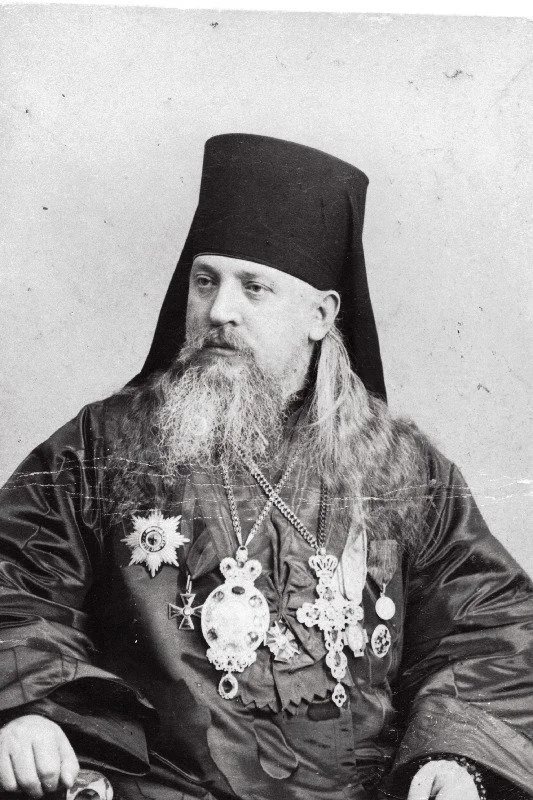
Archbishop Agafangel (Preobrazhenskii) of Riga, 1907 (EFA.563.0.181924)
In reality, Agapitov, who never claimed to be Metropolitan Agafangel (Preobrazhenskii) when pressed, seems to have been little more than a huckster. While accurately aping the format of a service list, his CV is so full of patent absurdities that it can never have been intended to stand up to serious scrutiny. Equally, Agapitov’s face and person were actually known in Riga and Kaunas in the early 1920s (before his claim to be a metropolitan emerged), and so he cannot have really intended to deceive churchmen. Instead, travelling to rural areas remote from the centres of power, Agapitov used official-looking documents bespeckled with seals and signatures to play off several factors: the collapse of both secular and ecclesiastical identification systems at the end of the war, the lack of news from persecuted church circles in the Soviet Union, and, much as the Romanov pretenders had done, a belief among the people that sacred figures of authority could volunteer or be compelled to walk among them in much humbler guises, thereby joining their plight.
Before we get to the sources, let us ask: was anything true in Agapitov’s biography? In his service list and various statements, he claims to be the son of a townsman from the Viatka town of Iaransk. After completing the Viatka seminary, Agapitov supposedly graduated from the University of Kazan’ in 1905: he was then assigned a position as a sacristan in the Saratov village of Chukhonastovka, purportedly being awarded a whole bevy of church and civil accolades for a panoply of services. Conscripted for the Great War in 1914 and becoming a regimental quartermaster, Agapitov alleges capture by the Germans during their march on Riga in 1917: after release, he returned to Saratov and became a priest. Soon after, he journeyed to Moscow, where he was raised to abbot, bishop, and archbishop in rapid-fire succession. At some point during this time, Patriarch Tikhon apparently ordered Agapitov to go and investigate Orthodoxy’s standing in the Baltics: hence his elevation to metropolitan of Vilnius in 1926.
Of course, virtually none of this is true. Lists of students from both the Viatka ecclesiastical seminary and the University of Kazan’ for the relevant years make no mention of anyone by the name of Pavel Agapitov [6]. One Pavel Agapitov, a townsman’s son and army reservist from Iaransk, was indeed appointed as a sacristan to the church of the Intercession in Chukhonastovka, Saratov diocese, in 1907 [7]. But there are no references in the Saratov diocesan journal of any awards going to this man. Instead, Agapitov was quickly transferred to two more parishes after Chukhonastovka before being removed from (and not restored to) the clerical roster in 1913 [8], potential signs of disciplinary problems.
Given his age, Agapitov was almost certainly conscripted in 1914; due to his evident literacy and previous position in the Church, it is not impossible he would have been made quartermaster. The 14th Siberian Rifles Regiment (the army unit cited by Agapitov) was involved in the campaign for Jelgava at the beginning of 1917 and so Agapitov may very well have been captured close to Riga.
The next trace of Agapitov is in Riga in the early 1920s, when he became known to the nuns of the Trinity convent of St Sergii and some members of the clergy. Evidently, he was not a Latvian citizen, and so it may be presumed he arrived as a refugee. In 1923, Agapitov departed for Kaunas, intending to become a priest in the diocese of Lithuania: after being refused by Archbishop Elevferii (Bogoiavlenskii) (1868-1940) due to poor reviews of his behaviour, he went to Polish-held Vilnius. In 1925, he reappeared in Latvian Latgale, now claiming to be Metropolitan Agafangel. In the autumn of 1926, he proceeded to Estonia, where he met Metropolitan Aleksander during anniversary celebrations of the Pechory monastery. He was arrested by Estonian police on 29 November for illegally crossing the Latvian border [9] and was held for three months until February 1927, at which point he returned to Riga and confronted the editors of the newspaper Slovo. Despite claiming that he wanted to go to Finland, he actually headed to Daugavpils, where he was arrested again. Despite being initially refused entry into Poland, he was able to enter Poland’s Belarusian territories, which is where he seems to have been caught in March 1927.
At this point, Agapitov’s trail goes cold: only further research in the archives of Saratov, Latvia, Poland, and Lithuania will further clarify both his past and his fate.
No. 1. Letter from Archpriest Evstafii Kalisskii [10], rector of the Kaunas cathedral, to Archbishop Jānis (Pommers), 6/19 March 1923.
Your Grace!
Permit me to ask you to transfer the attached letter to the cathedral archpriest so we can receive from him a review about Agapitov, which is necessary for our archbishop.
[…]
[Iu. L. Sidiakov, ed., Istoriia v pis’makh iz arkhiva sviashchennomuchenika arkhiepiskopa Rizhskogo Ioanna (Pommera) (Tver’, 2015), 1:380]
No. 2. Letter from Archpriest Evstafii Kalisskii to Archbishop Jānis (Pommers), 21 SEPTEMBER/9 OCTOBER 1923.
[…]
During Shrove week, [Archbishop Elevferii (Bogoiavlenskii) of Vilnius] ordained one deacon and four priests, since there are still free parishes (but Pavel Agapitov, who sent you a petition with many signatures, did not achieve ordination – his behaviour is shameful and has long been known here. He wanted you to make an error. Now he has already fled to Vilnius).
[…]
[Iu. L. Sidiakov, ed., Istoriia v pis’makh iz arkhiva sviashchennomuchenika arkhiepiskopa Rizhskogo Ioanna (Pommera) (Tver’, 2015), 1:381]
No. 3. Letter from Archpriest Miķelis Pētersons [11] to Archbishop Jānis (Pommers), 27 June 1926.
To Your Grace Jānis, archbishop of Riga and all Latvia
From Archpriest Miķelis Pētersons of the Daugavpils church of the Dormition
Report
Agapitov came to me recently. He looked so pitiful that I did not have the heart to unmask him. I made as if I did not recognise him. He asked for alms, and as certification of his identity he presented a document: attached to the page was Agapitov’s portrait and the signature ‘Metropolitan Agafangel-Agapitov’. Under the portrait was certification from the police that Metropolitan Agafangel-Agapitov’s signature was made with his own hand. On the page’s verso was the seal of some establishment of the Red Cross with a request to all the doctors and hospitals of the Red Cross of Latvia to offer medical assistance to Metropolitan Agafangel-Agapitov. I think the police who certified ‘Metropolitan Agafangel’s’ signature could not be so naïve as to be unable to distinguish a vagrant from a metropolitan: accordingly, the document should be taken from the hands of this vagrant, so that this popular hierarch’s name is not dirtied.
Your humble servant and novice,
Archpriest Miķelis Pētersons
No. 68
27 June 1926
[Iu. L. Sidiakov, ed., Istoriia v pis’makh iz arkhiva sviashchennomuchenika arkhiepiskopa Rizhskogo Ioanna (Pommera) (Tver’, 2015), 1:165]
No. 4. Pavel Agapitov’s self-authored service list, c. 1926.
INFORMATION on Metropolitan AGAFANGEL’s service in the ecclesiastical domain
Metropolitan Agafangel, in the world Pavel Mikhailovich Agapitov, was born on 28 September 1882 in the town of Iaransk, Viatka province, as the son of a townsman. A bachelor. He received secondary education in the Viatka ecclesiastical seminary and higher education in the historical branch of the historical-philological faculty of the University of Kazan’. In his last year at university, he was also an auditor of higher missionary courses, from which he graduated at the same time as graduating from university, in 1905.
On finishing university, from August of the same year he went on military service and was voluntarily assigned to the Saratov garrison: after serving the defined period, he was released into the reserves in 1906. In 1907, with a petition to His Grace Germogen, bishop of Saratov and Tsaritsyn [12], [Agapitov] was appointed as a psalmist of the church of the Intercession in the village of Chukhonastovka in the fourth deanery district of Kamyshin and fulfilled the duties of a circuit missionary in the district. In 1908, he was appointed as headmaster of the Chukhonastovka church parish school by the diocesan schools’ council. In 1909, he was unanimously elected by the deanery congress of the clergy as a delegate to the [Viatka] diocesan congress of the clergy. In 1909, he was unanimously elected by the deanery congress of the clergy for a three-year term as a member of the audit commission of the pension and burial funds. In the same year, he was appointed as inspector of church-parish schools in Kamyshin district by the diocesan schools’ council. In 1911, for exemplary and selfless behaviour and for zealous service to the Church of God, he was unanimously elected by the deanery congress of the clergy as a member of the deanery council with the duties of assistant dean and secretary of the council.
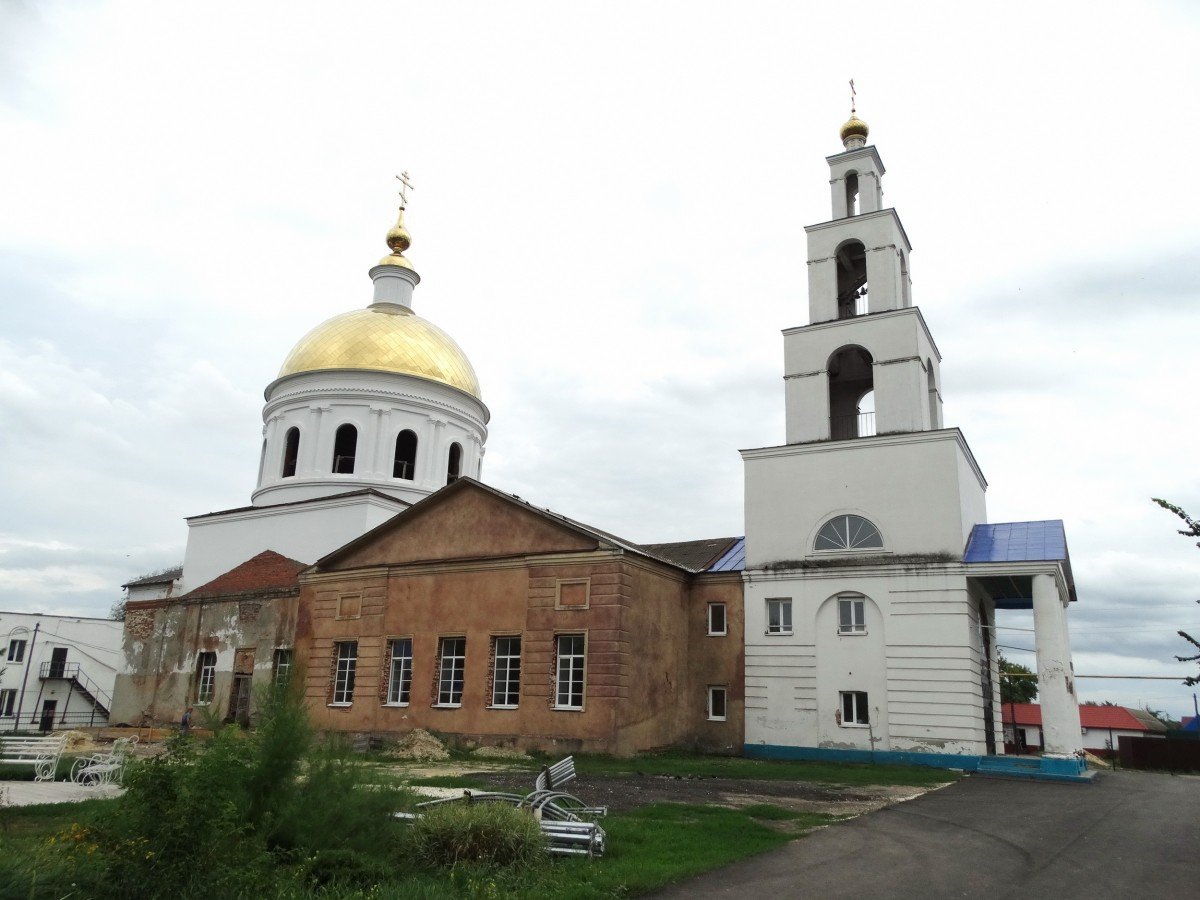
The church of the Birth of Christ in present-day Romanovka (Saratov diocese), close to where Agapov worked
As his service in the ecclesiastical domain continued, he was also occupied with expanding diocesan authority [through] positions and elections in peasant institutions, namely: chair of the Chukhonastovka savings and loans association of the Romanovka county office as the initiator and organiser of [this association]; the honoured chair of the Romanovka agricultural association, [appointed] for developing animal husbandry and aviculture and distributing model foreign agricultural machines and equipment among the peasant population; an honoured member of the Talovka society for the protection of animals of Kamyshin district as the initiator and organiser of [this association]; the honoured chair of the Kamyshin branch of the brotherhood of the Holy Cross as the initiator and organiser of [this association]; and member of the audit commission for the Kamyshin Orthodox guardianship for the poor. For zealous service to the Church of God and work in the mission and popular education, he was annually issued with a certificate of episcopal blessing. In 1913, by ruling of the diocesan schools’ council, heartfelt thanks were expressed for his work in popular education and a monetary award of 100 roubles was issued. In 1914, for his exemplary behaviour, care, diligence, and work in service to the ecclesiastical domain, heartfelt thanks were expressed and a certificate of the Holy Synod’s blessing was issued. In 1910, for the model organisation of the Romanovka agricultural association, the administrator of state property in Saratov province expressed heartfelt thanks with a certificate and a golden agricultural mark for wearing on the breast with the inscription ‘for zeal and labour to the Russian Agricultural Association’. In 1911, for organising an association for the protection of animals and personal work, diligence, and care for the association (equipping a veterinary clinic for the free treatment of peasant animals), the governor of Saratov expressed heartfelt thanks and issued for wearing on the breast a small silver medal on a St Anna’s ribbon [13] and inscribed ‘for labour’. In 1913, for organising a branch of the brotherhood of the Holy Cross and for personal labours, diligence, and cares (equipping a free tearoom for the poor and the needy, a shelter for 12 orphans, an almshouse for 20 of the aged needy, and a cheap canteen for poor pupils and the unemployed), a certificate of imperial thanks and a small gold medal with the inscription ‘for labours and cares to the almsfolk’ on a St Anna’s ribbon for wearing on the breast were issued.
In 1914, on the declaration of mobilisation, due to being in the army reserves, [Agapitov] was conscripted into the ranks of the 12th Active Army of the Northwestern Front and was assigned to the 14th Siberian Rifle Regiment to perform duties as regimental quartermaster. In 1917, on the capture of Riga by the Germans, he was taken prisoner.
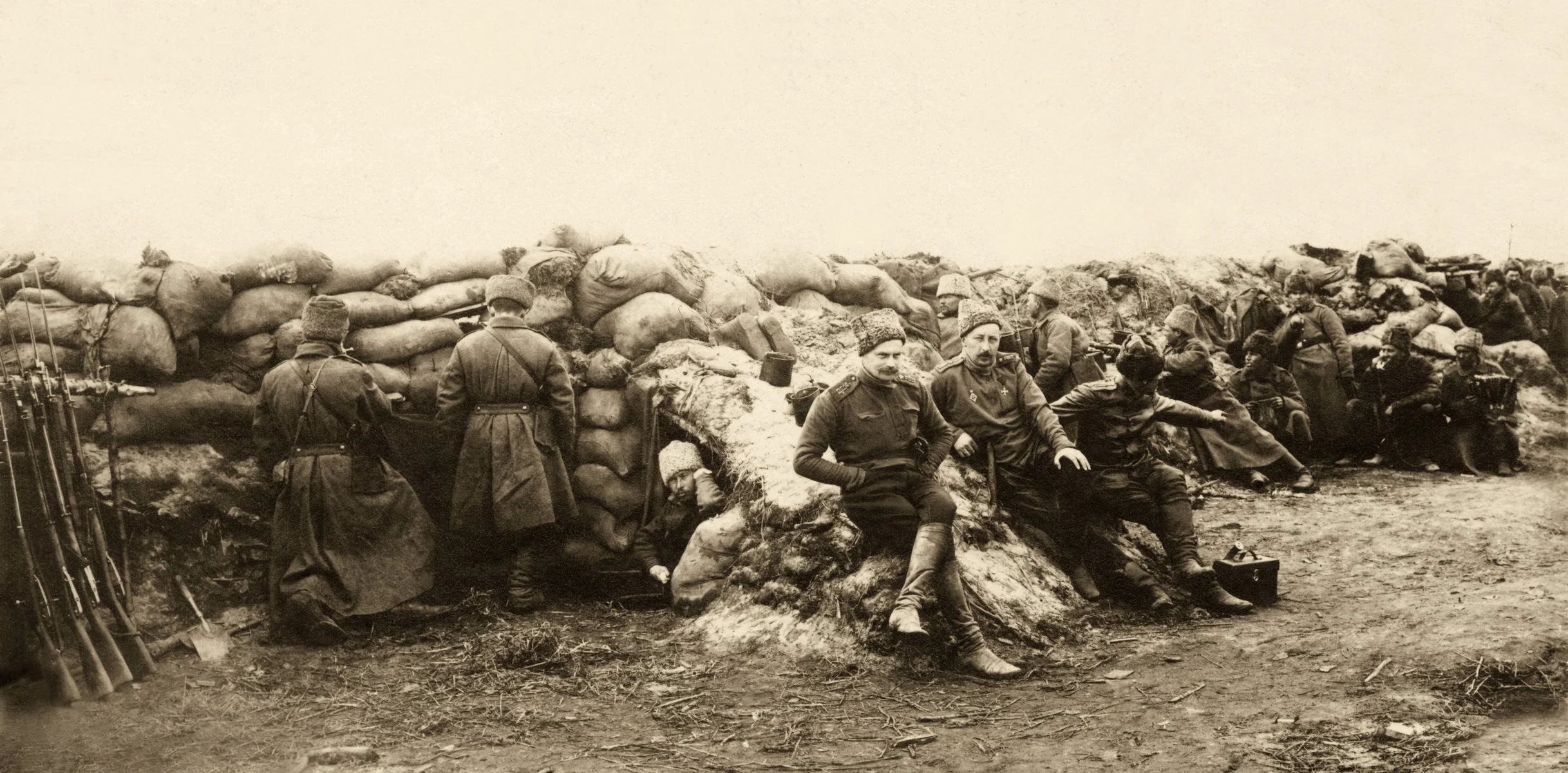
The 12th Siberian rifle regiment in position near Grodno, 1915 (not Agapitov’s alleged regiment, of which few pictures exist)
In 1918, on return to the city of Saratov, he was ordained as a priest: in the same year in the city of Moscow, he was tonsured as an archimandrite with the name Agafangel by His Beatitude Patriarch Tikhon and appointed as abbot of the Trinity monastery of St Sergii: he was sent abroad to the West to fulfil missionary duties and struggle with the [Old Believer] schism. In 1924, he was consecrated as a bishop. In the same year, for his labours, diligence, and cares for the Church of Christ and for energetic struggle with the schism abroad, he was raised to the rank of archbishop. In 1926, for his labours and struggle with the schism to the great advantage of the Church of Christ, he was rewarded and elevated to the rank of metropolitan to fulfil duties as the metropolitan of Vilnius and Lithuania and removed from his position as abbot of the Trinity monastery of St Sergii.
Signed
Metropolitan Agafangel
Register no. 17166
I the undersigned certify that this document was signed by hand in my presence (Petr Sotskii, fulfilling the duties of the Riga notary Andrejs Meikis in his office in Riga) by Agafangel Agapitov, who is personally known to me and who lives in Naujene parish in the village of [Zhindi] [14], Daugavpils district: he proves his identity through a certificate issued by the assistant chief official of the first region of Daugavpils district on 3 July 1926 (no. 20, Riga, 23 July 1926).
The consulate of the Union of Soviet Socialist Republics in Daugavpils certifies the authenticity of the signature of the Riga notary P. Sotskii certifying the service of metropolitan Agafangel […].
[…]
[Iu. L. Sidiakov, ed., Istoriia v pis’makh iz arkhiva sviashchennomuchenika arkhiepiskopa Rizhskogo Ioanna (Pommera) (Tver’, 2015), 1:174-177].
No. 5. Newspaper article: ‘Who is the Impostor Locum Tenens?’[15], 19 October 1926.
Yesterday evening, our Tallinn correspondent reported that one Agafitov [sic], who calls himself Metropolitan Agafangel, crossed the Soviet border. While the Estonian authorities are occupied with identifying whether this Agafitov is an imposter, in Latvia Agafitov’s impersonation has already long been known. In 1925, Agafitov illegally arrived in Latvia from Lithuania. The police have established that he spent six months vagabondizing: he spent some time in shelters and lived in Latvia without an entry permit.
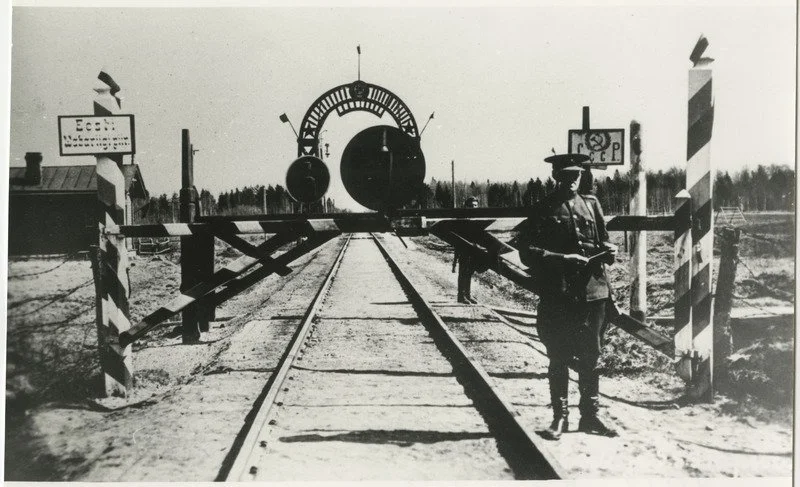
Estonian-Soviet railway border, 1930s (EAA.2073.2.203.1)
The Latvian authorities fined him for crossing the border illegally and proposed that he leave Latvia. Agafitov was then in torn clothes but held himself with some dignity.
He confirmed that he was permitted to travel to Palestine, showing a letter from the British consul in which it was said, however, that the British authorities did not give Agafangel permission to travel to Palestine.
He then presented a service list, which, as has recently become clear, was composed by him personally. According to the list, Agafitov worked for a long time in all arenas of the state and was awarded with 20 medals, including for services to spreading literacy, in the struggle against drunkenness, and in the struggle against cereal pests.
In 1914, he was allegedly one of the quartermasters of a regiment in the 12th Army. In 1918, he was ordained as a priest and, in 1924, was made a bishop and appointed as the abbot of the Trinity monastery of St Sergii. In the same year, as the service list states, he was ‘raised to the rank of archbishop and sent abroad for the struggle with the church schism’. In 1926, he ‘received the rank of metropolitan’.
At this time, the imposter has strenuously been petitioning for permission to live in Latvia and has promised that he will work for the good of the Latvian state. The impostor has even turned to the petitions office of the Saeima with a complaint against the ruling that forbids him to live in Latvia.
[‘Kto takoi samozvannyi mestobliustitel’, Segodnia, no. 235 (19 October 1926), 3]
No. 6. Newspaper article: Archbishop Jānis (Pommers), ‘A Pseudo-Metropolitan in Latvia and the Destruction of Orthodoxy’, 16 july 1926.
We have already written about the terrible destruction of the doomed Orthodox Church in Latvia, we have a long list of facts about this destruction.
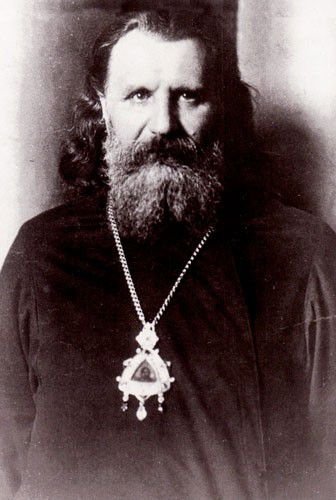
Archbishop Jānis (Pommers)
Today, circumstances again compel us to return to this sorrowful theme. The destruction continues. We Orthodox have not yet managed to pull ourselves together after the portentous smashing of the Straupes Latvian Orthodox parish, where, despite the republic’s law and practices, the parish church, the church land, and the parochial buildings, fully paid for with church money and indisputably owned by the parish for more than fifty years, were awarded to a private individual: the whole parish community has nowhere to pray, hear the word of God, baptise their newborns, hold weddings, or bury the dead, the whole parish community has been doomed to spiritual hunger and a slow, suffering death. When the Latvian Senate sanctioned this award, it seemed to us that a final and incontrovertible death sentence was pronounced on the Straupes parish.
Some credulous people console the Orthodox. They say: the situation is still fixable. Look to the courts to restore the Straupes parish’s rights. If the court recognises the parish’s rights to own its sacred heritage, then no force will be able to take it.
To many, such consolations are well founded. Many have imagined salvation in [the form of] a court sentence that guarantees the inviolability of the parish’s sacred heritage. [But] it is forgotten that neither the Straupes parish nor the central church authorities have the means for a drawn-out court case and that hope for a successful conclusion to this case is heavily undermined by the Senate’s twice-repeated decision on this question. The optimists affirm: there are still courts in Latvia, and there is no force that can match a judicial ruling. Today we received official news from the rector of a Latvian Orthodox parish that utterly destroys the faith of the optimists. A few years ago, claimants to the sacred heritage of the Liepna parish appeared. A court case began. On 4 February 1924, the Latgalian circuit court decided in favour of the Liepna parish. The court’s decision went into force. On 4 May 1924, to fulfil the court’s order, the parish took ownership of its property and began to dispose of it as its owner, praising the court and believing in the strength of its ruling. But in 1926, a Latvian land reform commission, regardless of the court ruling and article 893 of the law on court decisions, awarded the very same property to the very same claimant whose claims had been rejected by the Latgalian circuit court on 4 February 1924. The victorious claimant to the sacred heritage has already presented demands for the transfer of the property awarded to him by the land reform commission. The Liepna parishioners are in despair. Can the Liepna parish, one of the poorest in all Latgalia (and now even poorer), start a drawn-out case against the rich claimant to the parish’s sacred heritage and the powerful land reform commission? After the nightmarish Straupes case, can the Liepna parishioners count on winning in the Senate? The Liepna case is capable of plunging the Straupes parishioners into complete despair: what is the point of a court ruling for the return of their holy heritage when some powerful administrative institution does not have to take a court ruling into account, just like in Liepna?
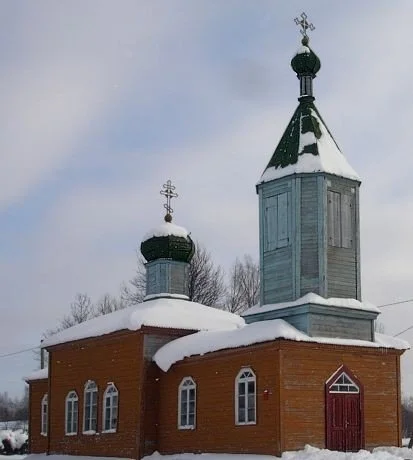
The Liepna church of St Elijah (original church destroyed in the 1940s)
These two cases, each mutually reinforcing the other, are literally terrorising the consciousness of the Orthodox, killing off in them what is left of their energy for self-defence. They have plunged us into complete despair: they have created among us the mood and conviction that Orthodox organisations cannot depend on the most elementary and sacred of rights, to own their temples, their church land, and their church buildings.
If until now almost all the forces of destruction predominantly struck the Russian Orthodox, the two most recent blows relate to purely Latvian Orthodox parishes. The bitterness of the struggle with the Orthodox clearly has reached a new phase, one where no quarter will be given. Unwillingly are recalled the winged words of a late politician [Zigfrīds Anna Meierovics] [16], who dreamed about an all-encompassing anti-Orthodox front that will exterminate everything Orthodox in its path: holy churches, organisations, institutions, everything reminiscent of Orthodoxy.
This politician openly dreamed about drawing everyone and everything in Latvia to this front, in a short time wiping away Orthodoxy from the face of our land with the same decisiveness that the Orthodox chapel was swept away from the square in front of the [Riga] train station. The late politician did not hide these dreams even from the head of the Orthodox Church when the latter came to him with a protest against coercion and other matters. Provoking amidst the people a purely mystical interpretation, this politician’s tragic sudden death broke the spiderweb of his dreams. For some time, it seemed that his dreams about a crushing, all-encompassing anti-Orthodox front died with him. We breathed freely. However, parliamentary speeches, articles in the periodical press, and the events of recent months force us to find that the late politician has ideological successors, again establishing an all-crushing and all-encompassing anti-Orthodox front. Again are issued wild calls to tear down our holies, to the ‘surgical’ extermination of church organisations, to openly talk about the ‘plucking out’ of Orthodox beards, again begins the smashing of Orthodox church organisations and their property. In a word, we Orthodox again feel that the notorious all-crushing and all-encompassing anti-Orthodox front is active once more. They again are trying hard to crush us not only from without, but also by bringing disorganisation and dissolution into our midst. We from the parliamentary tribune have noted the stubborn and illegal support for people harmful to Orthodoxy, rejected by both the parish and the central church authorities, at the head of Orthodox parish organisations. In these days, this fact is announced ever more strikingly.
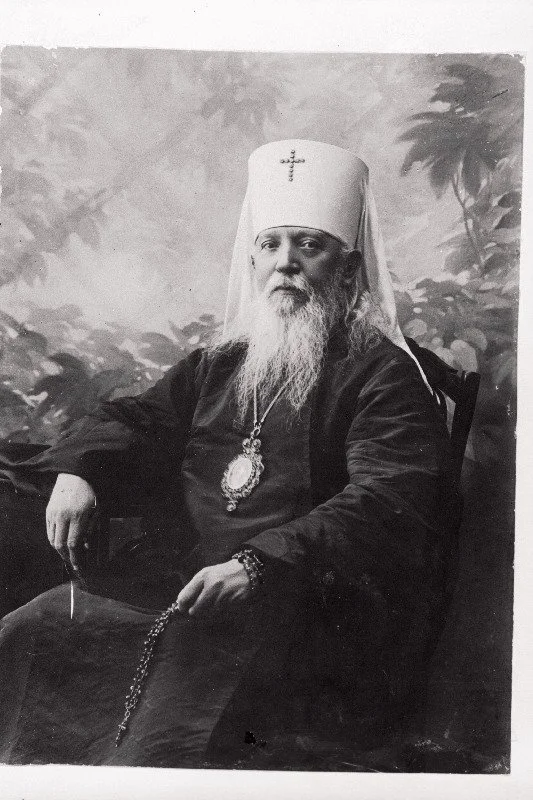
Metropolitan Agafangel (Preobrazhenskii) of Iaroslavl, 1921 (EFA.563.0.181946)
Everyone knows the astonishing severity with which we relate to so-called émigrés. In order to enter Latvia, even people with names from world literature, science, and art must fulfil a mass of formalities and pledge their timely departure. But by an unknown path, without formalities, without a pledge, an émigré with an unknown and, they say, very doubtful past and present has entered Latvia. In the presence of the severe anti-Orthodox front, this émigré, lacking ecclesiastical rank and doing a range of acts that are without doubt intolerable to the Orthodox Church, has suddenly off his own bat begun to call himself ‘Metropolitan Agafangel’. Of course, the impostor ‘Metropolitan Agafangel’ cannot come to Riga, where the real Metropolitan Agafangel (now second after the patriarch in the Russian hierarchy) is very well known. He has gone (and not accidentally, we suggest) to Latgalia, where they know [the real] Metropolitan Agafangel only by name. Recently, he was seen in Daugavpils and its environs. He not only calls himself ‘Metropolitan Agafangel’, but also presents documents in the name of Metropolitan Agafangel. Several enquiries have already been sent from Latgalia. The confused Orthodox are asking: is this really Metropolitan Agafangel? And if this is the real Metropolitan Agafangel, why has he come to Latvia? Why is he making his journey around Latvia as a dirty, ragged vagrant? Has he taken on himself the ascetic role of a holy fool? [17]
And what should we think about his strange political and ecclesiastical prophesying? If this is not the real Metropolitan Agafangel but a pretender, then is it permissible that he profanes with his imposture, behaviour, and speeches the honoured rank of metropolitan and the holy hierarch who left such a good memory of himself in Latvia? Referring to a cunningly assembled pack of documents of local provenance, the pretender is discrediting Orthodoxy and the Orthodox, making them a laughingstock among the non-Orthodox, and not without the knowledge of those who issued him the documents. In one neighbouring country [18], acceptance of this kind of antireligious propaganda is normal. But for our anti-Orthodox front, this is the first time they have lowered themselves to it.
What can we answer to the Orthodox asking about this?
What can be said to the upset, insulted, humiliated, and offended Orthodox? In the present circumstances, the actors and actions of the notorious anti-Orthodox front will face no justice. Only one thing remains to us – to ceaselessly and, if possible, loudly bellow about the injustices done to us in the hope of influencing social conscience as widely as possible. We know beforehand that our despairing cries will call forth only spiteful laughter from the entire anti-Orthodox front, and we will hear from the ranks of this front new summons: ‘Raze it, raze it, even to the foundation thereof!’ (Psalms 136:7) [19]. But, nonetheless, before all the civilised world, before the judgement of history and the judgement of God, we must bravely and openly confess that we have never and will never reconcile ourselves with injustice. We are hungry for and thirst for the truth! We protest against all those who do us injustice.
[‘Lzhemitropolit v Latgalii i gromlenie pravoslavie’, Slovo, no. 208 (16 July 1926), 1: see also Ioann (Pommer), Na strastnom puti Iova, ed. K. G. Aristov (Moscow, 2020): 122-125].
No. 7. Newspaper article: ‘Arrest of the pseudometropolitan’, 2 December 1926.
Agapitov is a pseudometropolitan
Tallinn, 2 December
One Agapitov was arrested here, as he had already twice crossed the border from Latvia and entered Estonia under the name ‘Metropolitan Agafangel’. The arrested man tells that Patriarch Tikhon in 1924 allegedly handed him missionary work and sent him abroad with this aim. Recently, he has been living in Latvia. The Estonian police’s investigation will undoubtedly reveal the pseudometropolitan’s fraud.
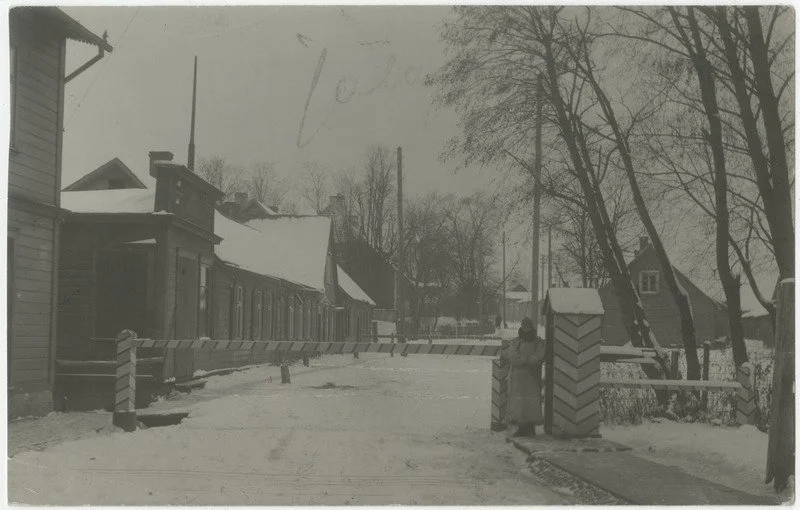
Estonian-Latvian border in Valga/Valka, interwar period (EAA.2111.1.15469.1)
On the arrest of the pseudometropolitan
Tallinn, 2 December. Private telegram.
The ‘metropolitan’ is very badly dressed. He announced sincerely: ‘The people in Tallinn are more generous than in the other cities of Estonia, not to mention Latvia. Here I have managed to acquire myself a pair of new boot legs in four days. If I hadn’t been arrested, then in a couple of weeks you would have seen me in a new outfit.’ Now Agapov will have to sit in jail for three months, after which they will send him back to Latvia.
[‘Arest lzhe-mitropolita’, Slovo, no. 347 (2 December 1926), 1]
No. 8. Petition from Pavel Agapitov while under arrest in Tallinn, 11 December 1926.
To the magistrate of the first district of Pechory region
From Metropolitan Agafangel (Agapitov), kept under guard in the jail of the Tallinn police
Petition
Given that all democratic republics (like Estonia) are countries of constitutional rule, giving all citizens living and dwelling in their borders full freedom and independence without distinction on the basis of nationality, faith, sex, or age (i.e., in other words, the right to the fullest respect for one’s personhood, which is, of course, for each citizen the most fundamental, most important, most essential, and dearest matter in his life), I most humbly ask you, by virtue of such rights and laws that exist in the republic (the deprivation of freedom in Estonia is illegal), to settle my case, which has arisen, according to the police protocols, due to the accusation against me of crossing the border illegally. [I ask you to] remove the administrative punishment placed on me by the head of the border guard of the Pechory region according to his ruling from 7 December, by which I [...], for the illegal crossing of the Latvian-Estonian border in November, was subjected to a monetary fine in the sum of 3,000 marks or, on being incapable of paying the fine, three months of arrest, a punishment I do not deserve by virtue of those circumstances that forced me to perform the aforementioned border crossing and which give me full right and cause [to ask for] the cancellation of the aforementioned punishment, illegally placed on me by the head of the border guard of the Pechory region and by which I am sitting in detention and deprived of freedom prematurely, without a court hearing. I dare to ask you to hear my case in court out of turn and without delay, since each day I spend under arrest on rations of bread and dry potatoes (like a monk) strongly affects my weak and ailing health, which requires constant clinical treatment.
In confirmation of the aforementioned, on the day of my court hearing I will present documents that confirm my innocence.
11 December 1926
Signed
Metropolitan Agafangel
[ERA.4440.1.2056, unpaginated]
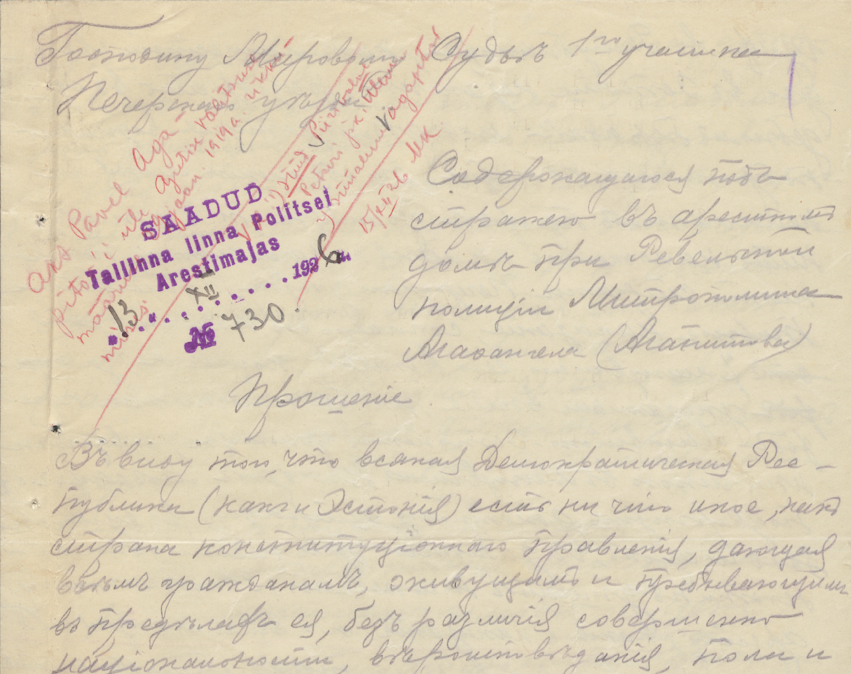
Agapitov’s petition from prison
No. 9. Newspaper article: A. Bakstrub, ‘impostor Pastors’, 20 December 1926.
Not so long ago, news about the arrest in Tallinn of the impostor Pavel Agapitov, who proclaims himself to be Metropolitan Agafangel, cropped up in local newspapers: only a few days later, the papers reported the travels of a swindler priest gathering ‘donations’ for persecuted Christians in Asia Minor.
Seeking to learn details about these imposters, I turned for an explanation to Metropolitan Aleksander [(Paulus)], who has personally talked with and seen these individuals.
Here is what His Grace told me.
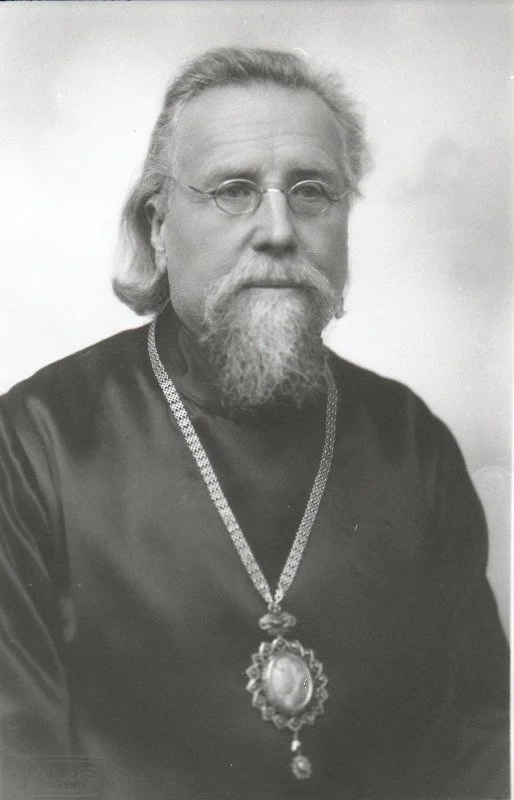
Metropolitan Aleksander (Paulus), 1933 (EFA.36.A.103.106)
‘Unfortunately, cases of imposters in the Orthodox Church have recently been observed more and more frequently. We are living through a time when, after great upheavals such as the world war and revolution, life has still not settled into a normal routine. Of course, these troubled times have been and are being used by various dark persons seeking easy money. Recently, countless such swindlers, hoping to ‘catch fish in troubled waters’, have appeared.
I’ll tell you about one of them, Agapitov.
During the celebrations of the 450th anniversary of the Pechory monastery (29 August), I, together with Archbishop Evsevii [(Grozdov)] of Narva and Bishop Ioann [(Bulin)] of Pechory performed a celebratory evensong. At the end of the liturgy, Archbishop Evsevii and Bishop Ioann removed themselves to the altar, while I went to bless the worshippers.
One of the last to come to the cross was a grey-haired old man with an unprepossessing appearance, in decrepit, shabby clothes. Coming up to me, he said rather loudly: ‘Metropolitan…’ It seemed to me that the old man wanted to say something more but thought better of it and did not finish the phrase he started. But, as it turned out, he later introduced himself to me.
In the evening, during the festal meal with Bishop Ioann, there was talk about the fact that a suspicious man had appeared in Pechory who proclaimed himself to be Metropolitan Agafangel and that this ‘metropolitan’ had found himself shelter in the cell of one of the monks. I was interested in this ‘metropolitan’ and wanted to meet him.
A few minutes later, the ‘metropolitan’ went to Bishop Ioann. I immediately recognised the same old man who had come up to me in church. This strange old man introduced himself to us as Metropolitan Agafangel, allegedly sent abroad by the Russian church authorities (the ‘Tikhonites’ [20]) with a missionary aim.
I said to him that I knew Metropolitan Agafangel [(Preobrazhenskii)] of Iaroslavl’ personally: he is tall, dark haired, and in general does not look like [this man]. The little old man now corrected himself and answered: ‘I am not that Agafangel, I am a different one.’
He then talked about himself: allegedly, Patriarch Tikhon consecrated him in 1924 as a bishop, after which he was appointed as archimandrite of the Trinity monastery of St Sergii. After the most holy patriarch’s death, he had been made an archbishop and, sometime later, a metropolitan. Then the ‘Tikhonites’ resolved to send him abroad as a missionary.
During the crossing of the Soviet-Polish border, the border guard had stripped him down to the last thread and seized all his documents: he was put in jail for illegally crossing the border. After leaving jail, he decided to try his fortune in another place and went to Latvia. But he had no luck: he was arrested for vagrancy and put in jail.
When he was released, he resolved to participate in the Pechory celebrations and so had come to Estonia. At the end of this story, someone among those present at the festal meal asked: ‘Tell us, father, how was your consecration performed?’ Obviously not expecting such a question, the metropolitan became nervous, fidgeted in his chair, and answered rather unclearly: ‘How?...Well, as always! As is expected! … According to all the rules!...’
Seeing that people were mistrusting him, he took out from his pocket a whole packet of documents, given in Latvia according to him, in which it was indicated that the bearer was Pavel Agapitov, who calls himself Metropolitan Agafangel, 46 years old. It was immediately obvious that we were dealing with an imposter because in fact he created the impression of a man of 60.
I left Pechory and did not meet [this man] again. Later I learned that ‘the metropolitan’ had crossed the Estonian-Latvian border two or three times without permission. Of course, ‘the metropolitan’ had to go to jail for illegal border crossing. When they asked what had drawn him to Estonia, he invariably answered: ‘In Estonia, people are more generous and responsive than in Latvia’.
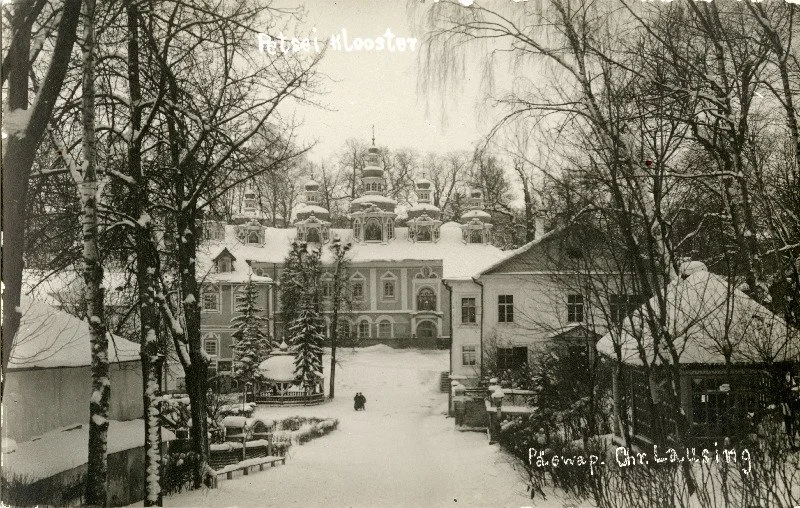
Pechory monastery of the Assumption, 1920 (EFA.554.0.186028)
Here is another type of pastor-impostor.
Some time ago, a handsome old man of an eastern type came to me and in broken Russian asked me for a blessing. He declared that he was the deacon Tsiia Gallien of one of the eastern Churches, who had been sent by his bishop to all the countries of Europe to gather donations for the widows and orphans of the Assyrian Christians tortured and killed by the Turks and the Kurds.
To confirm his words, this pastor, who, by the way, made a most pleasant impression on me, handed over a mass of various documents with the signatures of both his bishop and the higher clergy of different countries, along with the corresponding seals. The documents, written in French, confirmed that deacon Tsiia Gallien had indeed been sent to European countries to gather donations. I blessed the deacon, gave 500 marks for the Assyrian widows and orphans, and also gave him a recommendation to some of my acquaintances, asking them to give him help and assistance.
Graciously thanking me, the pious deacon left and did not appear again. Scarcely a week passed before another clergyman appeared, a priest of the eastern Church by the surname, if I am not mistaken, of Envedian. It seemed that he, like deacon Gallien, was gathering donations for Assyrian Christian refugees. But this pastor immediately struck me as suspicious. He smiled rather strangely into his black beard: he winked every now and then, and cunning could be seen in his dark eyes, covered by heavy eyelashes. I declared to him that I had already donated to his predecessor everything that I could give to the Assyrian Christians. There was nothing left for the priest but to leave, and I never met him again.
Days later, I was suddenly told the news. I was extremely astonished when I learned that both ‘Assyrian pastors’ were crafty fraudsters, impostors, and swindlers. The Berlin police had let our police headquarters know that around 25 swindlers calling themselves Assyrian priests are going around Europe and collecting money…for their own benefit. In the attached list were written the names of both of the ‘pastors’ who had met with me.
Nowadays, ended Metropolitan Aleksander, you don’t know who to believe: it could happen that some real priest might come to me, but I would take him as an impostor.’
[A. Bakstrub, ‘Pastyri-samozvantsy’, Ob’’edinenie, no. 1 (4) (20 December 1926), 5]
No. 10. Newspaper article: Archpriest Andrejs Jansons [21], ‘An Hour of Conversation with the Mysterious Pseudometropolitan Agafangel’, 16 January 1927.
Today we present a valuable letter about the pseuodometropolitan Agafangel’s travels in Latvia and Estonia, graciously sent to us by Archpriest A. Jansons.
‘More than a year ago, some kind of ‘elder’ entered Latvia as if by a miracle, proclaiming himself to be the archimandrite of the Trinity monastery of St Sergii and then ‘Metropolitan’ Agafangel. In the depths of the Latgalian countryside, a rumour emerged that the universally respected Archbishop (now Metropolitan) Agafangel, formerly of Riga diocese, had come to Latvia.
The elder masked his appearance with an entirely plausible mission: allegedly, His Beatitude Patriarch Tikhon sent him to become better acquainted with the religious and moral lives of the Orthodox population in Latvia, Estonia, and Poland. In November, rumours reached me that ‘Metropolitan’ Agafangel had already been acquainting himself for two weeks with the religious and moral life of the parishioners in my Veclaicene parish.
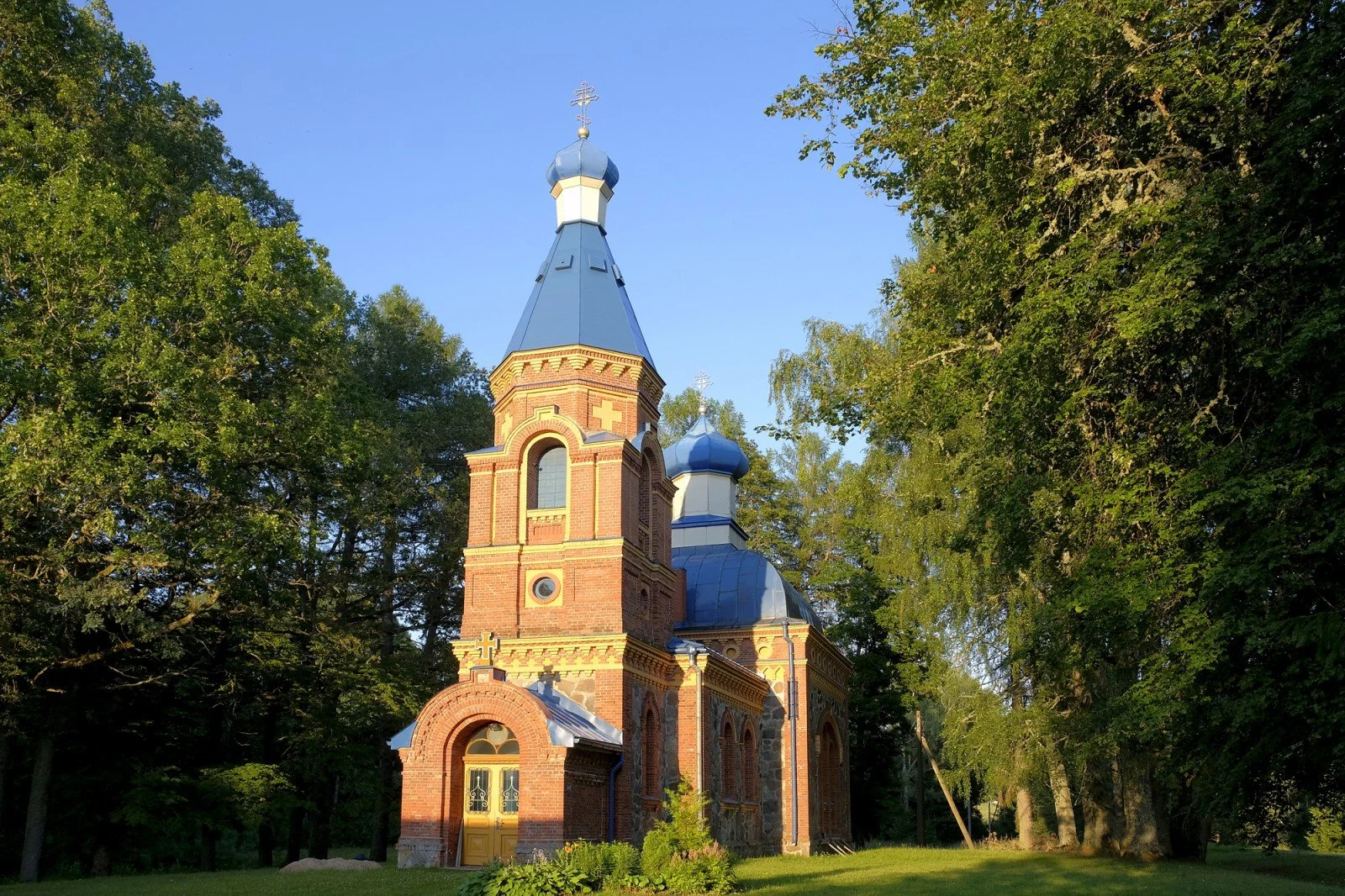
The Veclaicene church of the Theotokos today
Suddenly, on one wonderful day when I was not at home (I was doing my duties in Alūksne), my household told me that ‘Metropolitan’ Agafangel had come. In two-to-three minutes of conversation with my son, he managed to ask: do I have my own plot of land, do I work the land with my family or do I hire workers, how much do I pay each worker a year?! On this occasion, ‘Metropolitan’ Agafangel asked for a note about where the sexton, the sacristan, and the church elder live.
On the next day, I received from one of the honoured members of the parish council a note with the following contents: ‘an elder came to me and presented documents that he is Metropolitan Agafangel. He wants to go to Riga, but he has no means. Should I give some money from the church funds?’
I was to the highest degree interested in the secret person hiding under the high-sounding name ‘Metropolitan’ Agafangel and so I went home, where this highly placed guest was waiting.
Entering, I greeted him….to meet me came a handsome elder in a short, worn-out cassock with a small cross (neither gold nor bronze, without a rood) on his chest. We kissed brotherly three times and then, at the request of our hospitable hostess, sat down at the tea table.
For half an hour, we peacefully conversed about the standing of the Church of Christ in the USSR, Latvia, Estonia, Lithuania, and Poland. From the conversation, it was clear that my conversation partner was a former person [22] – many especially influential people were involved in church life and know by name and patronymic the abbots and treasurers of many monasteries, having quite exhaustive information about them. In a word, my conversation partner was a typical representative of a monastery fraternity, but he was not a monk or a hieromonk.
With great sorrow he told about the life and spiritual achievements of His Beatitude Patriarch Tikhon, who allegedly sent him for missionary aims across the border. In proof of such a mission, he showed Patriarch Tikhon’s portrait. Finally, I asked the elder an indiscrete question.
‘Who are you really, father?’
‘I…I am Metropolitan Agafangel…’ with indecisiveness and some bewilderment answered my conversation partner to my indiscrete question.
‘And do you have the necessary documents?’, I followed up.
‘Yes, I have them’, the ‘metropolitan’ confusedly answered.
‘I ask you to show them, if possible’, I continued.
My conversation partner drew from the inside pocket of his cassock a whole heap of various papers and, moreover, a complete page written with a typewriter and sealed at the Daugavpils consulate of the USSR and the office of the notary Meikis on 23 July 1926.
I read approximately the following: ‘I am a native of either Siberia or Samara province, in the world Pavel Agapitov, born in 1881; on finishing courses at the ecclesiastical seminary and the historical-philological faculty of the University of Kazan’ in 1905, I was assigned as a psalmist to a church: then I was assigned as the headmaster of a church parish school. I was elected as the chair of an agricultural association; for my labours in agriculture, animal husbandry, gardening, and cooperatives, an episcopal blessing was repeatedly given in thanks; for missionary labours, medals were issued, and so on, and so on. In 1918, I was ordained as a priest; in 1919, I was elected as archimandrite of the Trinity monastery of St Sergii; in 1921, I was elevated to bishop; in 1924, to the rank of archbishop; and in 1926, to the rank of metropolitan and removed as archimandrite of the Trinity monastery of St Sergii. With missionary aims, Patriarch Tikhon appointed me locum tenens of the Vilnius-Lithuanian metropolitanate, and so on.’ This document was signed: ‘Metropolitan Agafangel’.
‘You have certification that you have personally composed and signed, but don’t you have even one certificate, one letter signed by any bishop that you were ordained as a priest, an archimandrite, a bishop, and so on?’
No, he had not one certificate, not one service list [so signed].
Finally sure that I was dealing with an impostor, I announced:
‘I see, father, that you are an imposter hiding under the name of the universally respected Metropolitan Agafangel. I now understand your exceptionally quick rise up the ladder of the clerical hierarchy, particularly from the revolutionary year of 1918…Even though you don’t see me in full costume, I am a priest and I can prove this, even if I lose my documents. It is surprising that in the USSR they did not find one bishop or citizen who could confirm your statement with their signatures. With your deception, you can only fool simpletons in the village, not a conscious citizen of Latvia.’
After such a reception in Alūksne, ‘Metropolitan’ Agafangel took the train to Valga and then went across the border to Estonia. Leaving from Alūksne, he declared to the good man who sheltered him, ‘in a month, your rude priest will wallow in the mud when I come with a cross procession.’
In this story with ‘Metropolitan’ Agafangel, [the following is] more than strange: 1) on what basis did the authorities of the Republic of Lativa, without any checks of the pseudometropolitan’s documents, permit him entry into Latvia? 2) on what basis did such an authoritative government institution as a notary provide a seal for a statement that was clearly a rogue’s fictious idle fantasy?
A day after the pseudometropolitan Agafangel’s stay in Alūksne, he managed to again take a copy of his more than doubtful statement and seal it at a local notary, who then discovered the clearly forged draft document issued by the notary Meikis on 23 July 1926. In the phrase ‘a person not known to me’, the word ‘not’ had been scraped away, leaving the expression as ‘a person known to me’.
Are not the pseudometropolitan Agafangel’s Latgalian conversations an ominous echo of the communist agitation in Pechory region, where the very same pseudometropolitan Agafangel was living and working at that time? [23]
Is there no connection between the sad events in Pechory, the arrest of the pseudo-metropolitan Agafangel, and his imprisonment in the Tallinn fortress? [24] The mysterious appearance of the notorious ‘metropolitan’ Agafangel in Latvia and Estonia provokes many perplexing questions: while it is still not too late, it is necessary to investigate his mysterious person and activities.’
Archpriest A. Jansons
Alūksne, 27 December 1926
[A. Ianson, ‘Chas besedy s zagadochnym lzhe-metropolitom Agafangelom’, Slovo, no. 389 (16 January 1927), 7]
No. 11. Newspaper article: ‘Pseudometropolitan Agafangel at the Editorial Board of Slovo’, 2 February 1927.
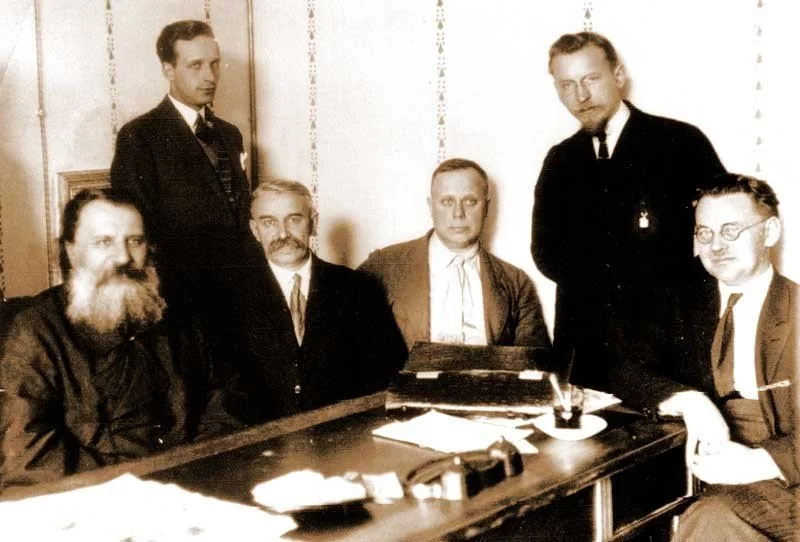
Editors of the newspaper Slovo sitting with Archbishop Jānis (Pommers)
Yesterday afternoon, a gaunt, unprepossessing, poorly dressed man came to the editors. He went up to our colleague and presented himself: ‘Metropolitan Agafangel’. Further, the newcomer asked on what basis Slovo calls him a ‘pseudometropolitan’ when he is a real metropolitan.
The ‘metropolitan’ gave a whole heap of certificates that, at first glance, looked solid: from the chancellery of the president, from the main board of the Red Cross, copies with dozens of signatures. But all of these were copies, even copies of copies.
‘And where are the original documents?’
‘In Paris, at the Orthodox Synod.’
We inspected the documents. [There was] a long service list. From this we saw that Pavel Agapitov was born in 1882 in the town of Iaransk, Viatka province, that he graduated from the ecclesiastical seminary and the University of Kazan’, then held the position of psalmist, school headmaster, and others, and was occupied with social activism. The list of all Agapitov’s awards took up three large pages.
In 1917, he was taken as a prisoner of war: in 1918, on return from imprisonment, he was ordained as a priest. Agapitov’s ecclesiastical career has gone unusually quickly. In one and the same year, he ascended from priest to archimandrite, was appointed abbot of the Trinity monastery of St Sergii, and raised to the rank of archbishop.
‘Why did you come to Latvia and how long have you been here?’
‘In 1918, I was sent by the late Patriarch Tikhon to the Baltic states for struggle against the schism and missionary activities.’
‘What form did your activities take?’
Agapitov hesitated slightly.
‘I clarified the position of the Church and the mood of the Orthodox population’, he replied cagily.
‘If you want to struggle [against the Old Believers] then you would need to organise lectures, missionary debates. Did you do this?’
‘No. I debated individual people.’
‘You haven’t acted against the sectarians?’
‘Yes, in individual cases. But in Latvia, as in Poland, Catholicism poses the main danger.’
‘You were in Poland?’
‘Yes, I initially visited Lithuania and Poland, and then Latvia. I was once in Estonia: now I have come to Riga, passing through on my way to Finland. With this, my mission will be complete. It is only a shame that they think me some kind of impostor’.
‘You forget that Metropolitan Agafangel was long the archbishop of Riga and Jelgava, and so he is well known here.’
‘Did I ever say I was that Agafangel[?] He is the locum tenens of the patriarchal throne, he is in exile, and he is more than 70 years old. I am much younger. I am Metropolitan Agafangel, abbot of the Trinity monastery of St Sergii. In the world, I am Agapitov, he is Preobrazhenskii.’
‘In your papers, it comes across that you received the rank of metropolitan in 1926. But by this time, Patriarch Tikhon was no longer living. Who consecrated you?’
Agapitov again hesitated. He mumbled something like that he had received his rank in 1925 but the instruction about this only reached him in 1926.
‘You have taken offence that you are not recognised, but the clergy have taken offence at you, since you have turned not to priests, but to sacristans. If you really are a representative of the patriarch, why have you not acted officially? Shouldn’t you have some kind of mandate?’
The answer was again cagy.
‘Well, you are visiting Finland and finishing your mission. To whom will you write your report about the position of the Church in bordering states?’
‘To Domian (editor’s note: Damian), the patriarch of Jerusalem [25]. And I am convinced that on the basis of my report, a patriarchate will be established in the Baltic region. This is necessary here.’
‘Who, in your opinion, can elect the Baltic patriarch?’
‘A church council, of course. It will be convened in August on Mount Athos [26]’. (According to the information available to the editors, no church council, neither ecumenical nor local, has been proposed for the autumn on Mount Athos).
‘They say that you have been leading earnest agitation against the new calendar. Why?’
‘It is impermissible. Individual churches have transferred to the new calendar without permission.’
‘But the late Patriarch Tikhon permitted this?...’[27]
‘Untrue. His instruction is not so clear.’
Agapitov became excited. His eyes began to shine.
After two or three more questions, the visitor bade us farewell. I asked his address.
‘The Trinity convent of St Sergii’ [28].
After Agafangel’s departure, the editors sent a note to the convent, which produced the following results:
‘Agafangel has absolutely not stayed in the convent, he was here once during the liturgy. He is well known here from the time when he still only called himself a layman. He often visited the convent’s services. Before his departure to Lithuania, he told Father M[ikhail] Burnashev [29] that he hoped to be soon ordained as a priest and asked him to serve a parting prayer for him, which was done. Even at this time, he caused a rather strange impression.’
[‘Lzhe-mitropolit Agafangel v red. “Slova”, Slova, no. 406 (2 February 1927), 3]
No. 12. Newspaper article: ‘The Pseudometropolitan Agafangel in Daugavpils’, 28 February 1927.
Recently in Riga, the pseudometropolitan Agafangel Agapitov has appeared in Daugavpils. He was taken to the Polish border, but Poland refused to accept him. According to the expressed desire of the pseudometropolitan, he was then taken to the Soviet border. It is unknown whether Agapitov has been accepted into Soviet Russia.
[‘Lzhemitropolit Agafangel v Dvinske’, Slovo, no. 432 (28 February 1927), 1]
No. 13: Newspaper article: ‘The Pseudometropolitan Agafangel in Poland’, 4 March 1927.
Acquiring for himself wide fame in the new Baltic states, Agapitov, who calls himself Metropolitan Agafangel, has again appeared in Poland. As is known, the first time Agapitov was in Poland was in 1924: he spent almost a year in Vilnius and then was sent by administrative order to Lithuania [30].
Now Agapitov has arrived in Poland from Latvia. He crossed the border at the town of Druja, Braslaw district [31], on 15 February. From Druja, Agapitov went to the locality of Novapagost and from there to the village of Sharkawshchyna, Disna district. Neither the military nor the civil authorities put any obstacles before Agapitov, who was, according to him, making his way to Warsaw. In Sharkawshchyna, Agapitov went to rest in the home of the local Orthodox priest, Father Rodion Radulovich [32].
The latter let the arrival of the pseudometropolitan be known to the local police, who arrested Agapitov and took his documents from him: he has been sent to the district authorities in Hlybokaye.
[‘Lzhe-mitropolit Agafangel v Pol’she’, Slovo, no. 436 (4 March 1927), 1]
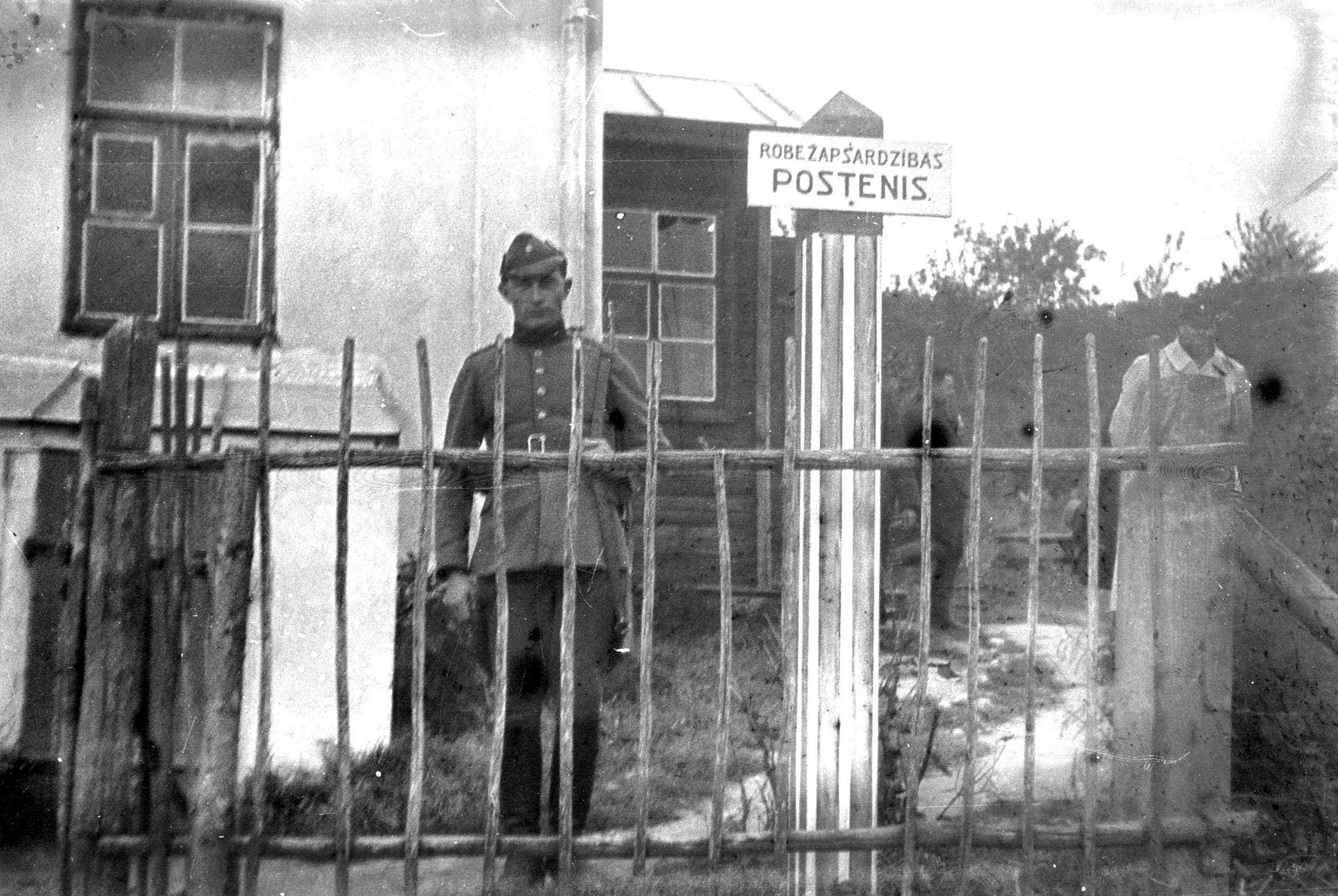
Polish-Latvian border, 1934
Notes
[1] For forging birth and marriage certificates, see the case of Archpriest Ioakim Leshchinskii and Archdeacon Aleksandr Sakharov in 1921-22 in EAA.1655.2.2599 (unpaginated) and EAA.1655.2.2600 (unpaginated); for people smuggling across the Soviet border, see the allegations against Father Mikhail Kliarovskii in 1923 in ERA.14.13.2952.
[2] The sacristans Vladimir Boltov and Petr/Feodor Bronin-O’Konnel both received jail sentences in the early 1920s (see ERA.4360.1.1733 and ERA.1868.1.564, respectively), but neither mention this in their church service lists (see, respectively, EAA.1655.2.2819 (unpaginated) and EAA.1655.2.2733.42).
[3] Founded in 1337, the Moscow Trinity monastery of St Sergii of Radonezh is arguably the most famous Orthodox monastic institution in Russia.
[4] For the trial of the spies, see A. K-g., ‘Protsess pechorskikh shpionov’, Posledniia izvestiia, no. 65 (15 March 1927), 3; no. 67 (17 March 1927), 3; no. 68 (18 March 1927), 3; no. 69 (19 March 1927), 3; no. 70 (20 March 1927), 3; no. 71 (22 March 1927), 3.
[5] For instance, one author, discussing numerous fraud cases in Latvia, directly connects Agapitov with the eighteenth-century Cossack rebel Emel’ian Pugachev, who claimed to be the murdered Peter III. N. Berezhanskii, ‘Iz palachei – v geroi’, Slovo, no. 314 (30 October 1926), 4.
[6] NART, f. 977, op. 1, t. 1.
[7] ‘Rezoliutsiiami Ego Preosviashchenstva predostavleny mesta’, Saratovskii dukhovnyi vestnik, no. 39 (1907), 15.
[8] ‘Rezoliutsiiami Ego Preosviashchenstva predostavleny mesta’, Saratovskii dukhovnyi vestnik, no. 6 (1913), 3.
[9] ‘Isehakanud mitropoliit’, Sakala, no. 146 (2 December 1926), 1.
[10] Archpriest Evstafii Kalisskii (1865-1954) served as rector of the Kaunas cathedral from 1921 to 1954. He was a major figure in Lithuanian Orthodoxy in the interwar period.
[11] Archpriest Miķelis Pētersons (1873-1952), priest of the Daugavpils church of the Dormition from 1923 to 1930. See https://www.russkije.lv/ru/lib/read/m-peterson.html
[12] Germogen (Dolganov) (1858-1918), bishop of Saratov from 1903 to 1912.
[13] A St Anna’s ribbon – a red ribbon with yellow edges used for most imperial medals.
[14] I have been unable to identify the Latvian name of this settlement.
[15] Locum tenens – deputy or place holder. This is a reference to the title of Metropolitan Agafangel (Preobrazhenskii), one of several bishops to act as the locum tenens of the Moscow patriarchate until an election could be held to replace the deceased Patriarch Tikhon (Bellavin).
[16] Zigfrīds Anna Meierovics (1887-1925) served both as a prime minister and foreign minister of Latvia from its independence until his death in a car accident in 1925.
[17] Holy fool - known in Russian as iurodstvo, becoming a holy fool is an Orthodox practice whereby a person rejects worldly possessions and social acceptability, thereby humbling themselves and emulating Christ.
[18] The Soviet Union.
[19] In the King James Bible, Psalms 137:7.
[20] The Tikhonites were those in the Russian Orthodox Church loyal to Patriarch Tikhon, as opposed to the Renovationists, who broke with the Moscow Patriarchate to create their own reformist Church backed partially by the Soviet state.
[21] Archpriest Andrejs Jansons (1871-1948), priest of the Veclaicene parish from 1919 to 1939.
[22] In other words, a member of one of the many social groups repressed and stripped of their rights by their Soviet government.
[23] This seems to be a reference to a Soviet spy ring arrested in the Pechory region in 1926 and tried in 1927.
[24] The police documents in Agapitov’s arrest file make no mention of such a suspicion.
[25] Damian I (1848-1931), patriarch of Jerusalem from 1897 to 1931.
[26] Mount Athos (Greece) is an important centre of Orthodox monasticism: the island is currently the site of 20 monasteries.
[27] Patriarch Tikhon did indeed grant some autonomy to the Estonian and Latvian Orthodox Churches in 1920 on whether to use the Julian (old) or the Gregorian (new) calendar. However, the shift to the new calendar provoked considerable dissent in some parishes, especially in Estonia.
[28] The Riga Trinity convent of St Sergii was founded in 1900. For its founders, see https://www.balticorthodoxy.com/the-mansurova-sisters
[29] Archpriest Mikhail Burnashev (1882-1928), priest of the Riga Trinity convent of St Sergii from 1925. See: https://www.russkije.lv/ru/pub/read/pokrovskoe-cemetry/svjaschenniki-3.html
[30] Vilnius was held by Poland from 1920 to 1939: throughout this period, the capital of Lithuania was Kaunas.
[31] All the following locations are today in Belarus, so Belarusian names are used.
[32] Archpriest Rodion Radulovich (1885-1960), priest of Sharkawshchyna church of the Dormition from 1921 to 1960.
Translator and editor
James M. White
Date added
18 February 2026