Dr David Papp (1937-2019)
Tireless Archival Activist in Exile
David Papp was born on 12 January 1937 in Rakvere, Estonia. His childhood was deeply rooted in Saaremaa, his parents’ ancestral home and the location of his father’s brick factory. In 1944, the Papp family fled to Sweden to escape the Soviet occupation. Settling there, Papp worked his way through the Swedish educational system all the way to doctoral level. In 1977, he defended his PhD dissertation on maritime history at the University of Stockholm. His professional life was defined by the sea; he spent many years working in Swedish and Finnish naval museums, focusing on historical maritime connections between the peoples of the Baltics.
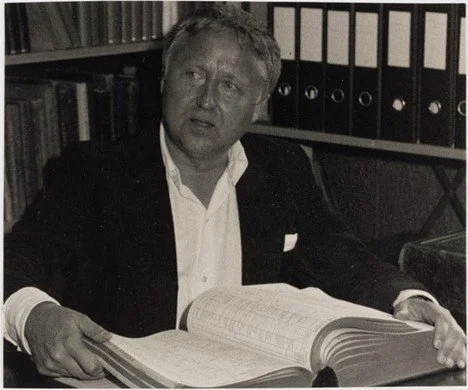
David Papp c. 1986 (ERM Fk 3051:15445).
Alongside his distinguished career as a maritime historian, Papp was an active member of the Estonian Apostolic Orthodox Church (EAOC) and became a central figure in researching its history. In the post-war era, the exiled Church was forced to rebuild itself from the ground up, eventually establishing around thirteen parishes, some as distant as the USA and Australia. Papp emerged as one of the most prominent figures engaged in reconstructing the EAOC’s historical memory. Apart from his academic specialisation in maritime history, his personal devotion led him to take a keen interest in the Church's past. As a young historian, he was confronted with the reality that historical sources regarding the Orthodox Church in Estonia were either lost or trapped behind the Iron Curtain in his occupied homeland. Recognising the absence of source materials in exile, Papp began independently gathering information about the Church’s history. In 1968, he approached the EAOC’s Synod with a proposal to formalise this effort, after which the Synod officially tasked him as church archivist with gathering historical data related to parishes and prominent figures.
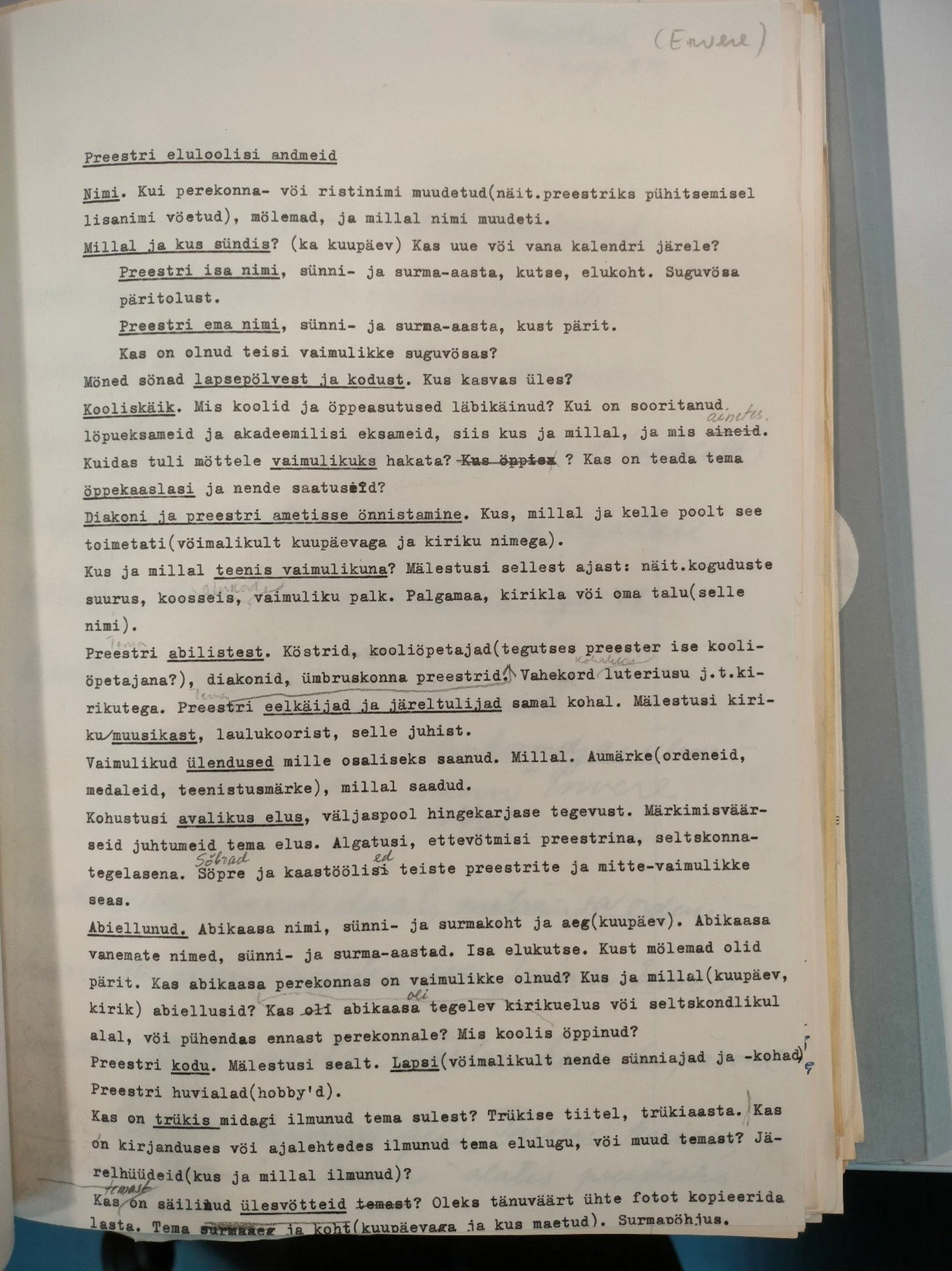
Papp’s questionnaire regarding priests’ biographical details (EAA.5410.1.155).
Papp initially placed appeals in the EAOC journal Jumala Abiga, published from 1950 by Father Sergius Samon in Los Angeles, and in Swedish-Estonian newspapers to gather memories regarding Orthodox life in Estonia. But this met with limited results. Soon, he shifted to a more personal method of gathering sources, corresponding directly with members of the Orthodox diaspora. This approach proved more fruitful, eventually resulting in a large collection of source material.
Papp was aware of the challenges: outside his home country, he only had access to photos and memories. As he wrote to fellow parishioners, he was concerned that ‘[of the little that was taken to exile], much will be lost, and the data will only survive for a few generations’. As a methodical historian, he also sent a detailed questionnaire to community members at the beginning of the correspondence.
Naturally the quality of data was an issue. As the Estonian diaspora in North America was collecting data of victims of Soviet repressions, Papp was contacted in hopes of receiving information regarding the Orthodox population. Papp replied that:
I have compiled a small list of those persons in the church archives who disappeared or fell victim to the Bolsheviks. I would like to emphasise that the data is very approximate and very ‘uneven’ – it only concerns persons about whom, for some other reason, I have tried to obtain information from their relatives. Only when it comes to priests is this list more or less complete.
All the more reason Papp had to encourage the diaspora to contribute. When one community member was worried about the truthfulness of his memories, Papp encouraged the author:
Please don't care about accusations of ‘village tales’ or the like! If we started writing our history (or biographies) like official obituaries, this ‘history writing’ would be very modified, improved, and would not give any kind of picture with both positive and negative sides. Who would believe or be able to read these rearranged and embellished monographs! [But] this does not mean that folk tales do not require criticism either!
After the closure of Jumala Abiga, the documentation of Orthodox life in exile found its principal venue in the journal Usk ja Elu, which ran from 1971 to 1994. Serving as the newspaper’s editor-in-chief and frequent contributor, Papp published congregational histories and biographical sketches. He also used the journal to encourage others to share their experiences of church life in interwar Estonia or even earlier, such as publishing memories of the Riga ecclesiastical seminary during the imperial period.
Additionally, in 1955 Papp founded the EAOC cultural fund, which supported the Church for decades by publishing literature and providing smaller parishes with recorded services and sermons.
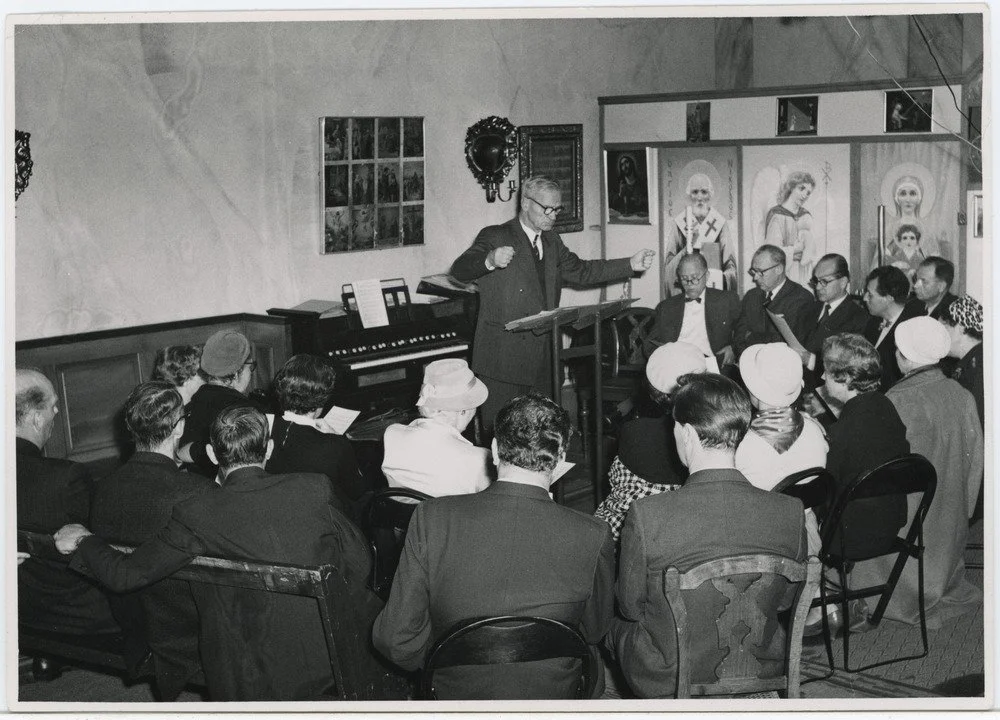
Singing at the Estonian Orthodox church of St Nicholas in Stockholm, 1950s-70s (EAA.5355.1.384.23)
As the secretary of the EAOC’s Synod, Papp also played a central role in the eventual winding down of the Church's operations abroad after the restoration of Estonian independence. In 1993, Estonian law recognised the EAOC in exile as the legitimate successor of the interwar EAOC. With the decisions of Estonian Church Councils in 1999 and 2000, the Church regained canonical continuity on Estonian soil. Consequently, the Synod in Stockholm was dissolved. In 1999, Papp oversaw the transfer of the Church’s archives from Stockholm to Estonian national repositories. This included over 600 files detailing the Church’s activities and the lives of its clergy.
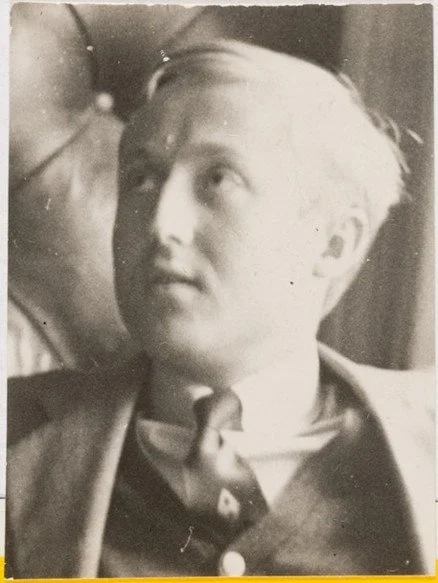
David Papp c. 1976 (ERM Fk 3051:15447).
In 2007, Papp transferred his personal archives to Estonian National Archives. Over the decades, his collecting activities had produced a massive assemblage of documents, some fifty volumes of correspondence filled with memoirs and biographical accounts. These document not only the histories of clergy and laity in the imperial and interwar pasts, but also detail the social and cultural realities of Orthodox communities in Sweden, Australia, the United Kingdom, and the United States during the Cold War. Thanks to his interest in photography, Papp was also gathered around 1,500 photographs, many of which are used on this very website to visually illustrate the historical legacy of Baltic Orthodoxy.
Papp passed away in 2019 at the age of 82. His personal collection, along with the Synod’s official archive that he curated, offer a rich, multifaceted history of the Estonian Orthodox diaspora. His collection work and personal research have become the foundation for new investigations into Estonian Orthodox history, partly through his own publications and partly through an online database dedicated to the EAOC’s clergy (https://www.eoc.ee/eesti-apostlik-oigeusu-kirik/vaimulike-andmebaas/). Papp’s collection work will no doubt continue to offer unique prospects for future research on Baltic Orthodoxy.
Sources
Eesti Entsüklopeedia.
‘Eesti Apostliku Õigeusu Kiriku arhiiv ja Eesti Skautluse Arhiiv jõudsid Rootsist Ajalooarhiivi Tartus’, Tuna, no. 3 (2000): 147-148.
EAA.5355 - Eesti Apostliku Õigeusu Kirik eksiilis.
EAA.5410.1.155. Correspondence of D. Papp.
EAA.5410.1.165. Correspondence of D. Papp.
Jumala Abiga, no. 80 (1968): 30.
Vaba Eesti Sõna (21 May 1970): 7.
Eesti Päevaleht (Estniska Dagbladet) (13 November 1997): 6.
Saarte Hääl (17 September 2019).
David Papp’s photo collection in the National Archive of Estonia: https://www.meediateek.ee/photo/search?q=EAA.5410&l=1
Author
Albert Ludwig Roine
Date Published
17 April 2026