Richard Valdak (1891-1968)
Orthodoxy, Greek Catholicism, and Tallinn Interwar Decadence
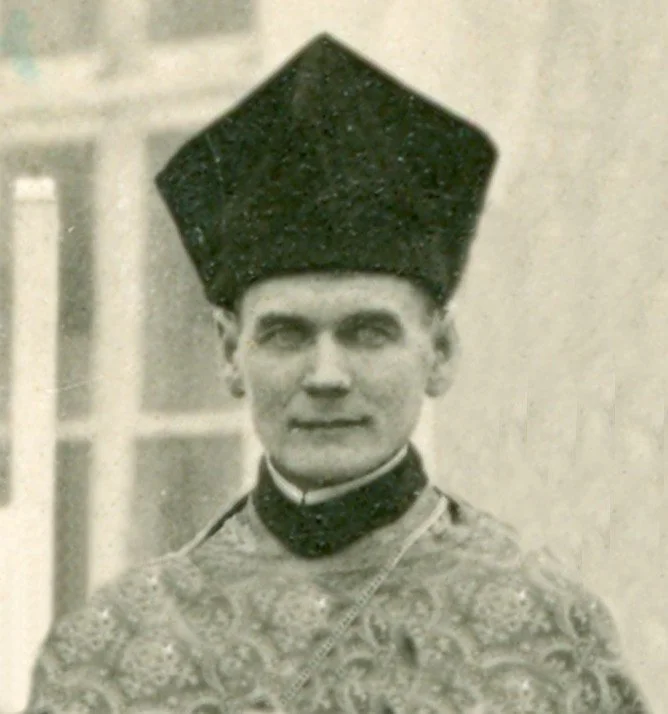
Richard Valdak as a Catholic priest
Richard Valdak was born on 17/29 March 1891 in Tallinn to Hindrik and Katharina Elisabeth Platsipeal/Platsipealt, a Lutheran couple: he one of three siblings. His father and uncle were labourers. He attended a grammar school but left before graduating. As a young man, Valdak took part in the Uue Turu rally in Tallinn on 16 October 1905 and was reportedly wounded in the exchange of fire.
In the first half of the 1920s, Valdak worked as a guitar and orchestra instructor at the Sunday school of the Lutheran Transfiguration congregation in Tallinn. He took the surname Valdak in 1923, when the Supreme Court granted him permission to change his name. According to the newspaper Vaba Maa, Valdak then worked as an actor at the Grand Marina Revue Theatre in Tallinn. However, in 1927, he had a sudden change of vocation and confession, choosing to become an Orthodox priest. Passing q theological examination in the Estonian Apostolic Orthodox Church in 1927, he was appointed as a priest to the church of the Resurrection on the island of Vormsi, a parish that mainly served Swedish-speaking parishioners.
His career in the Orthodox Church was a short one: in 1928, Valdak was removed from his position and defrocked. He then converted to Roman Catholicism and spent the next few years working to establish a Greek Catholic (Uniate) parish in Haapsalu. Dating from the Union of Brest of 1595-96, the Uniate Church was founded as a means to draw Orthodox Christians under the aegis of the Roman Church, offering converts the right to continue using Orthodox liturgical rituals so long as they acknowledged the primacy of the papacy. Over the coming centuries, the Uniate Church had a significant presence across eastern Europe. However, the Russian Empire regarded the Uniates as ‘lost’ Russian Orthodox, tricked by Jesuit missionaries into abandoning the ‘national’ faith. Consequently, when the Polish partitions of the late eighteenth century occurred, the imperial state began campaigns to forcibly transfer Uniate parishes and believers to the Russian Orthodox Church. This culminated at the Council of Polotsk in 1839, which ended the legal existence of the Uniate Church on Russian territory. However, many believers and their children retained their loyalty to their prohibited faith: when apostasy from Orthodoxy was legalised in the empire in 1905, many thousands chose to return to the Uniate Church. Following the First World War and the emergence of the independent states of Estonia, Latvia, and Lithuania, the Roman Catholic Church sought to expand its influence in the region: one means of doing so was founding and promoting Uniate flocks, much to the chagrin of Russian Orthodox priests in particular.
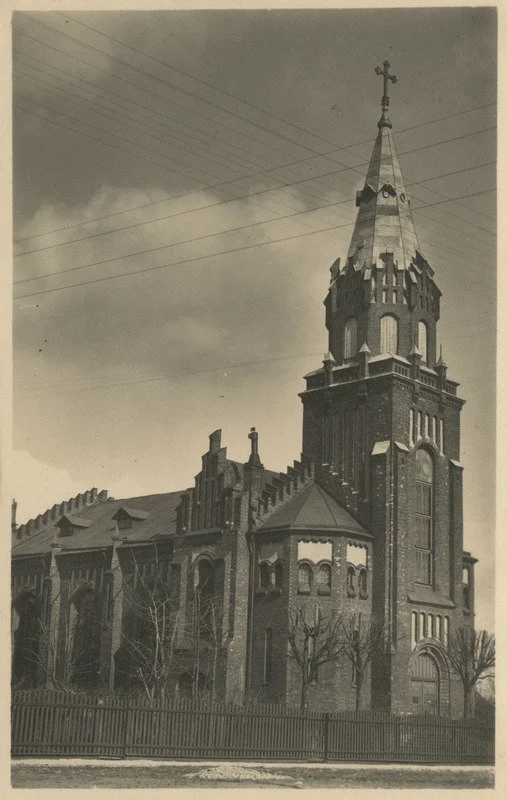
The Catholic church in Narva, 1940 (EAA.5266.1.1237.135)
On Valdak’s initiative, the Haapsalu Uniate parish was established in 1929; with foreign aid, a detached house on a plot in the town centre was purchased and converted into a church. A dozen or so Orthodox émigrés of Polish provenance joined the congregation. On 19 December 1929, Valdak preached in Narva as a Uniate priest in Estonian and Russian at a solemn service marking the jubilee year of Pope Pius XI. He later described the Uniate congregation in Haapsalu as an entirely unique project[1].
Nonetheless, Valdak could not stay out of trouble. In 1930, he was involved in a brawl in Haapsalu when he was attacked by a drunken man. At the same time, he also came into conflict with the local apostolic administrator, Eduard Profittlich (1890-1940). Valdak was ordered to undertake further theological training abroad, as his ability to conduct the Roman Catholic mass was deemed insufficient. As he refused to undertake the training in 1931, he was prohibited from celebrating Mass and, later, from performing other religious services. By order of the Haapsalu magistrates’ court, he was evicted from his official residence, required to return the keys, and fined, along with being ordered to pay court costs. Despite the ban, Valdak continued to hold services. The conflict came to a head on Christmas Eve 1930, when Valdak was unable to enter his church to conduct a service because the caretaker had locked the doors. Valdak then called the police and held the service in the presence of law enforcement officers. The commotion continued on Christmas Day, when the church doors were locked again and Valdak turned to the police once more. The dispute reached the Haapsalu district court, and Valdak was sentenced to a fine of seven crowns or one day’s imprisonment, plus a further five crowns in court costs. The church caretaker complained that Valdak had sworn at and insulted him in the presence of others, a claim corroborated by witness statements.
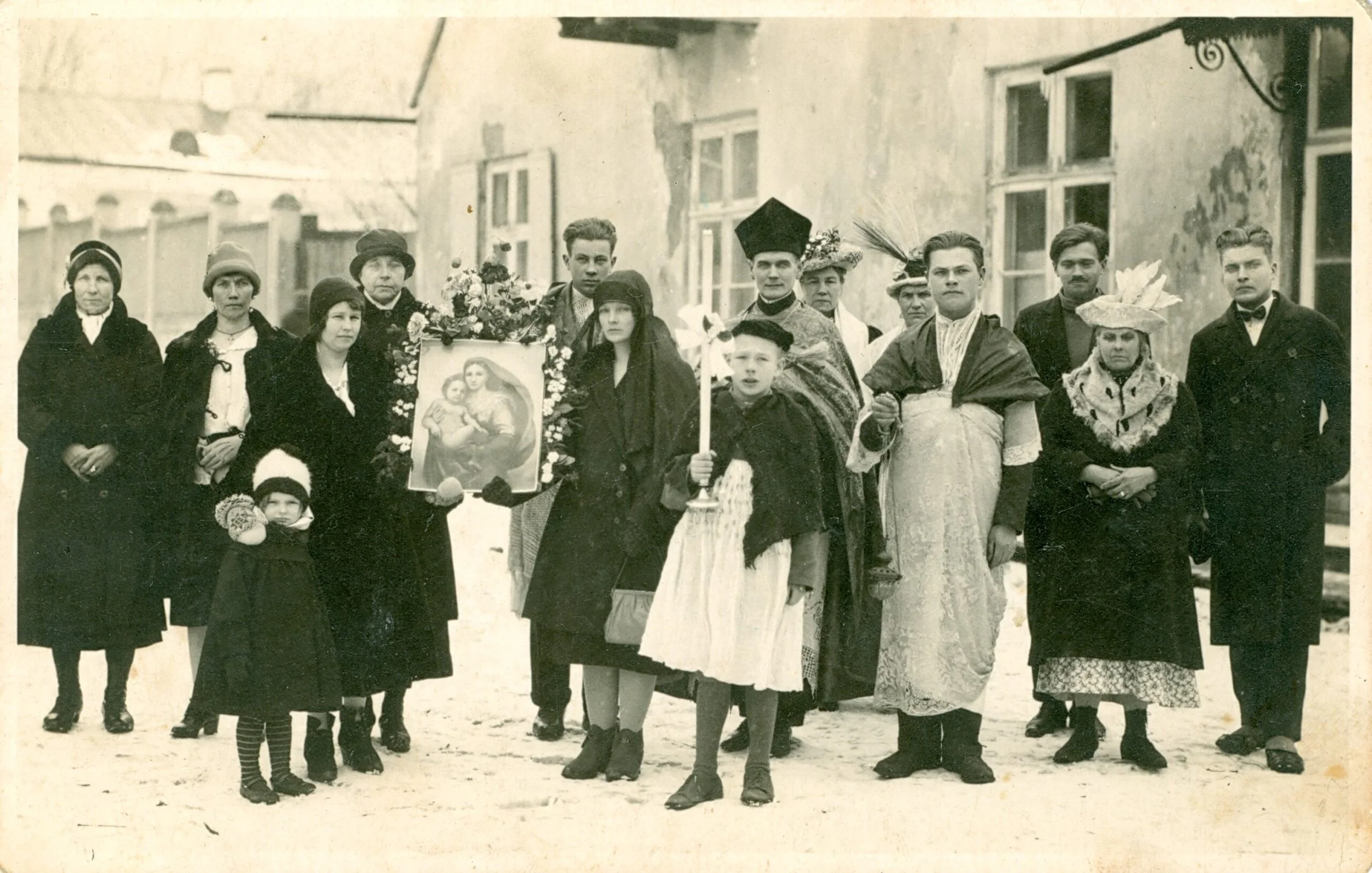
Valdak with his Uniate congregation
In 1931, Valdak moved to his parents’ house in the Lilleküla district of Tallinn. He focused mainly on secular activities, presenting himself to the public as an artist and freelance actor [2]. According to press reports, Valdak ran a salon for sexual minorities at his home, which came to be known as Tereese Castle: here, gatherings and men’s costume parties featuring wigs, dresses, and role-playing were held, counter to the moral and social norms of the time. Valdak is said to have conducted ‘marriage’ ceremonies for men at these parties. Valdak’s home, much like the interwar subcultures of Berlin and Riga, was lavishly decorated with religious symbolism, including icons, candles, gold and jewellery [3].
In November–December 1933, an anonymous series of articles entitled ‘The Purple Horror’ appeared in the newspaper Rahvaleht, drawing public attention in derogatory terms to men in Tallinn who were seeking homosexual relationships, including Valdak [4]. Having received information about the building from the newspaper, the building inspectorate found that the house did not comply with fire safety requirements. In March 1934, it was decided that the building was unfit for habitation, as it had been constructed without a permit from the city council and in contravention of building regulations; Valdak was fined 10 crowns or three days’ imprisonment. Valdak’s new place of residence became a house at Mooni 12. Between 1933 and 1937, hewas mentioned repeatedly in the press in connection with public order issues, referring both to his role as a property owner and as a victim of vandalism. For example, in 1937, his house was broken into, and items were stolen and smashed. The court sentenced the perpetrator to two years’ imprisonment.
In 1935, Valdak was sentenced to one year in prison for giving false testimony. Valdak attempted to feign mental illness in court, but a medical examination found him to be of sound mind. However, whilst in prison, Valdak was admitted to Seevald mental hospital for treatment in 1937. After the Second World War, Valdak was evacuated to Cheliabinsk. Upon returning to Estonia in 1945, he moved into his parents’ house, which had been nationalised, and was allocated a 13 m² flat. Valdak was constantly in dispute with his neighbours, regarding which he submitted repeated complaints and petitions in the 1950s to the Council of Ministers of the Estonian SSR and the Tallinn City Housing Authority [5].
Richard Valdak passed away on 26 December 1968 in Tallinn as a result of a burst blood vessel. He was buried as a layman at Rahumäe Cemetery in Tallinn. The Orthodox Archpriest Nikolai Kokla conducted his funeral service at the church of the Transfiguration in Tallinn.
Notes
[1] ‘Ühe kiriku telgitagusest’, Vaba Maa, no. 21 (25 January 1931), 6.
[2] Ibid.
[3] ‘Lilla õudus’, Rahvaleht, no. 111 (2 December 1933), 5; ‘Tereese loss maatasa!’, Rahvaleht, no 118 (19 December 1933), 4; ‘Linnukesed kohtulaua ees’, Vaba Maa, no 65 (18 March 1934), 7.
[4] ‘Lilla õudus’; ‘Tereese loss maatasa!’.
[5] ERA.R-1.20.2482, LVMA.573HA.2.209
Author
Father Andrei Sõtšov
Sources
A. Kaljukosk, ed., Õigeusu kirikutes (kogudustes) teeninud vaimulike nimekiri (Tallinn, 1975). EAA.5437.1.64.
A. Kalkun, ‘Tasa-arvoisen avioliiton historia: Kertomatta jääneitä tarinoita Viron LGBT-yhteisön historiasta ja suhteista Suomeen’, Elo, no. 1 (2024): https://www.tuglas.fi/tasa-arvoisen-avioliiton-historia
D. Papp, Eesti Apostliku Õigeusu vaimulikud – biograafiline leksikon (16.–20. saj). EAA.5410.1.247–249.
R. Põldsam, ‘Why Are We Still Abnormal?!” History of Discourses on Non-Normative Sex-Gender Subjects in Estonia’ (PhD diss., University of Tartu, 2023).
‘Richard Valdak’, Eesti Apostlik-Õigeusu Kirik, https://www.eoc.ee/vaimulik/valdak-richard/
‘Richard Valdak’, Wikipedia, https://et.wikipedia.org/wiki/Richard_Valdak
TLA.1358.2.43; 1878-1940, lk 375/495.
ERA.5201.2.781.
ERA.R-1.20.2482.
LVMA.573HA.2.209
Kaja, no. 228 (3 October 1922), 10.
Põhja Kodu (19 December 1929), 1.
Lääne Elu: Läänemaa häälekandja, no. 80 (20 October 1930), 1.
‘Ühe kiriku telgitagusest’, Vaba Maa, no. 21 (25 January 1931), 6.
‘Sõimas kiriku kojameest – preester Valdakule 1 päev aresti’, Vaba Maa, no. 26 (31 January 1931), 3.
‘Tallinnast’, Vaba Maa, no. 41 (18 February 1931), 7.
‘Lilla õudus’, Rahvaleht, no. 111 (2 December 1933), 5.
‘Tereese loss maatasa!, Rahvaleht, no. 118 (19 December 1933), 4.
‘Linnukesed kohtulaua ees’, Vaba Maa, no. 65 (18 March 1934), 7.
‘Tereese loss suleti’, Hommikleht, no. 62 (17 March 1934), 2.
‘Tallinnast’, Vaba Maa, no. 201 (28 August 1934), 7.
‘Polizeichronik’, Estländische Zeitung für Heimat und Fortschritt, no. 195 (28 August 1934), 6.
‘Ema ja poeg tunnistasid valet’, Uudisleht, no. 186 (24 November 1936), 6.
‘Tallinnast’, Vaba Maa, no. 225 (1 October 1937), 9.
Date Published
3 April 2026