Father Vasilii Blagodatskii (1888-1921)
Refugee and Murder Victim
At the end of 1919, the swampy hamlet of Kriushi (Krivasoo/Kriuša) was engulfed by the chaos of modern war. Sitting on the banks of the River Narva near a strategic bridge, the village was the site of a last stand: having failed to take Petrograd (St Petersburg) in September, a force of White Russian and Estonian units dug in to resist a Bolshevik advance on Narva. The artillery bombardments in the area were so intense they reminded some observers of the bloody Battle of Verdun on the Western Front [1]: on 9 December alone, more than 1,000 Bolshevik shells careened into Kriushi in just over four hours [2]. Armoured trains and military aircraft accompanied thousands of troops, freezing in temperatures below -20 degrees Celsius. Kriushi was repeatedly raided and counterraided. The bridge was set aflame. The Orthodox church of St Alexander Nevskii was pummelled: its roof was heavily damaged, its windows shattered, its doors destroyed, its walls pockmarked by shell hits and machine gun fire. Both sides ransacked the altar, the library, and the archive, leaving precious little in their wake [3].
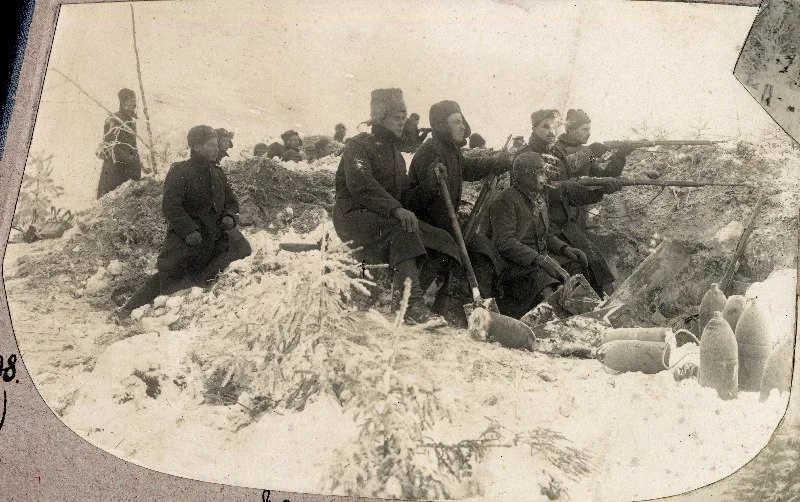
Soldiers of the 6th Infantry Regiment of the Estonian army dug in near Kriushi, 22 December 1919 (EFA.51.A.266.110)
The Bolsheviks had an overwhelming numerical advantage: meanwhile, the demoralised White troops fraternised with their Red adversaries, exchanging tobacco, rations, and weapons on the frozen waters of the River Narva [4]. But even when pushed out of Kriushi itself, the Estonian forces held the line. Their stout defence was vital for peace negotiations: with a strong hand intact, the Estonians were able to wrangle territorial concessions out of the Soviet Union in the 1920 Treaty of Tartu, including Kriushi itself.
Raimund Kull, Krivasoo lahing = The Battle of Kriushi (1920). Performed by the Estonian National Wind Orchestra and the Estonian Youth Wind Orchestra (conductor Bert Langeler, 16 November 2025).
Not far from the frontlines, a humanitarian catastrophe unfolded in Narva and its hinterlands: tens of thousands of Russian refugees and soldiers were dying of the cold, hunger, and the ravages of a typhus epidemic. Among their number we would find Father Vasilii Blagodatskii, his wife Antonina, and their three children. Just under forty as of 1920, Blagodatskii, the son of a clergyman from St Petersburg province, had spent most of his career in the Orthodox Church as a deacon, his low rank probably a consequence of his incomplete education at the St Petersburg ecclesiastical seminary: he finally attained the priesthood only in 1917. However, war forced him out of his new parish, and he became a regimental priest for the White Army fighting against the Bolsheviks in Estonia and northwestern Russia [5].
The sources are mostly silent about Blagodatskii’s personal experiences of the dread revolutionary years: it is possible that he lost a brother, Father Aleksei Blagodatskii, to typhus in March 1920 in one of Narva’s hospitals. So, Blagodatskii was among the fortunate: avoiding death or consignment to physical labour in the peat factories and timberyards of northeastern Estonia (the fate of many refugees), he was instead elected as a priest for the war-shattered church in Kriushi on 9 May 1920, largely on the recommendation of Archpriest Konstantin Kolchin (1875-1941) of the Narva church of the Sign.
Notwithstanding the recent damage, the hamlet was not the worst place to end up: picturesquely perched on a stream of the River Narva, it was home to a tavern, two blacksmiths, and a windmill. In the summer, its 276 residents either toiled on the land or travelled to urban centres for work; in the winter, they rafted timber down the waterway, sending logs mostly to the factories of Kreenholm. Travel to the outside world was easily accomplished through the regular steam ferries coursing the river. And, once a year, the outside world came to Kriushi: on the day of St Alexander, a market fair was held, selling sweets, meats, and pies [6].
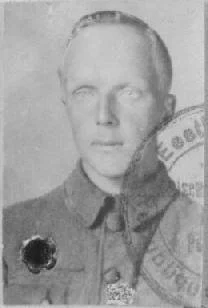
Deacon Nikolai Zadvinskii, 1927 (ERA.14.15.2482)
Blagodatskii’s luck did not last. Coming to his new parish in 1920, he encountered another clerical émigré, the deacon Nikolai Zadvinskii (1890-1953): having left his wife behind in the Soviet-held town of Ostrov (Pskov region), the thirty-year-old Zadvinskii, after serving as a reader in the White Army during the war, had been hired at almost the same time as Blagodatskii to serve as the Kriushi congregation’s sacristan[7]. The working relationship between the two men was far from cordial. According to later testimony from Archpriest Kolchin, Zadvinskii sought Blagodatskii’s job as priest and so was trying to undermine his superior’s authority in front of the parish community [8].
But these arguments suddenly and violently escalated on Friday 14/Saturday 15 October 1921. The village was preparing to celebrate the feast of the Intercession (1 October in the Julian calendar), an important holiday in the Orthodox Church and local life. As one witness described:
Many visitors arrived in our village from neighbouring villages, each staying with relatives or acquaintances. On such festive occasions the priest goes from farm to farm preaching, and in each household the priest is given monetary donations for the service or memorial rites, and is offered vodka, beer, etc. [9]
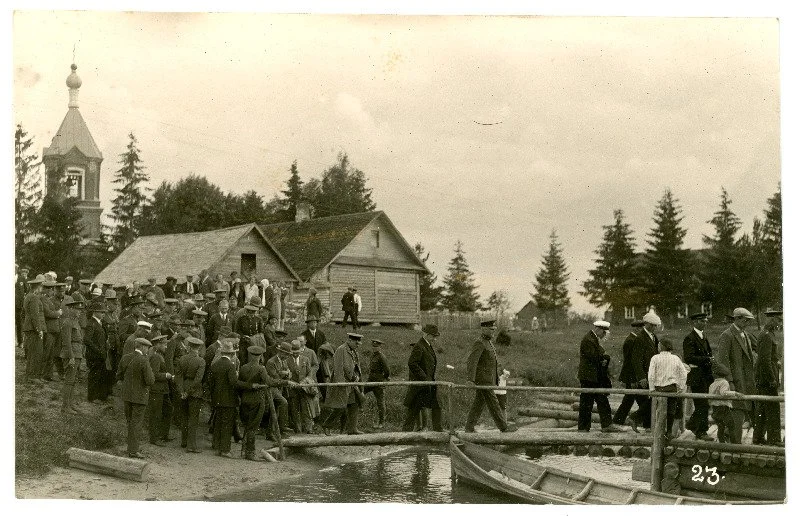
Kriushi church of St Alexander Nevskii, 1929 (ERA.5117.1.21.7.1)
Blagodatskii and Zadvinskii thus began their round of the village, performing prayers, taking donations, and occasionally indulging in alcohol at each household. Importantly, it was Zadvinskii who pocketed the money. By about five in the afternoon, the pair reached Gavriil Grigor’ev’s house, where some renovations were ongoing. Grigor’ev had organised a small party of five people, with the men sitting at one table and the women at another: among the guests was Andrei Prokof’ev, a 34-year-old agricultural labourer who had apparently lost his house to wartime bombardment [10]. Grigor’ev tells us what happened next:
When everyone had become warmed by drink, the priest suddenly told the deacon that the latter had no right to collect money during the service, that this should be done by him, as the senior clergyman. The deacon in turn remarked that the priest himself was not acting properly either and had kept for himself all the grain and food donations given by the villagers. During the argument, the deacon took the money collected from the village during the day and threw it onto the table, which the priest gathered up and put into his right-hand pocket. The drinking continued, and finally we began to sing. When the singing ended, the priest asked Andrei Prokof’ev, who had a notably good voice, to begin another song. Prokof’ev replied that he knew only one more song, which concerned a “Russian priest”. Such a remark displeased the priest, and he said that if you sing such a song, then you are a commissar. Prokof’ev gave a sharp reply, saying: “If I am a commissar, then you are a devil’s priest.” Upon these words the priest stood up and declared that it was impossible for him to remain together with such persons and commissars. He asked me to see him out, which I did [11].
According to another account:
Andrei [Prokof’ev] told the priest that if the priest came to him to collect the grain emolument, he would give nothing to the priest but would give the prescribed emolument to the deacon. The priest then called [Prokof’ev] a communist. After this, the argument between the priest and [Prokof’ev] became so heated that they were about to come to blows. but Gavriil Grigor’ev prevented this. The priest then said that he did not wish to socialise with such communists and began to go home [12].
At this point, a spur-of-the-moment conspiracy seems to have occurred. With minds no doubt clouded by vodka and anger, Zadvinskii in some way encouraged Prokof’ev to chase down the departing Father Blagodatskii and attack him [13]. Then either Prokof’ev took a piece of timber from the construction yard at Grigor’ev’s house or Grigor’ev himself actually handed the wood to Prokof’ev, telling the latter in which direction Blagodatskii had gone. Prokof’ev then set off into the dimming evening in pursuit of his prey. As the assailant himself later confessed:
I went along the street and found the priest lying in the mud in the middle of the road. Even though the priest was already lying on the ground, I struck him with the same club that Grigor’ev had given me. I do not know where exactly the blow landed. After the blow I heard the priest making gurgling sounds, so he was undoubtedly still alive before the blow I delivered. I threw the club with which I struck him beside the priest; I do not know in what position the club remained. I immediately left, so I did not touch the body and did not take any money or anything else from him [14].
Prokof’ev then returned to Grigor’ev’s, after which the two went with the other guests to a dance being hosted nearby.
Despite Prokof’ev’s protestations that he wasn’t a thief, just a murderer, the estimated 2,500 marks of donations were not found in Blagodatskii’s pocket when his bloodied corpse was discovered the next morning. This grim burden fell on the housewife Fekla Sysoeva when she opened her door after kneading some dough for the coming day. An autopsy reported that the cause of death was a blow to the right side of the forehead, one delivered with such force that it fractured the skull and caused a brain haemorrhage.
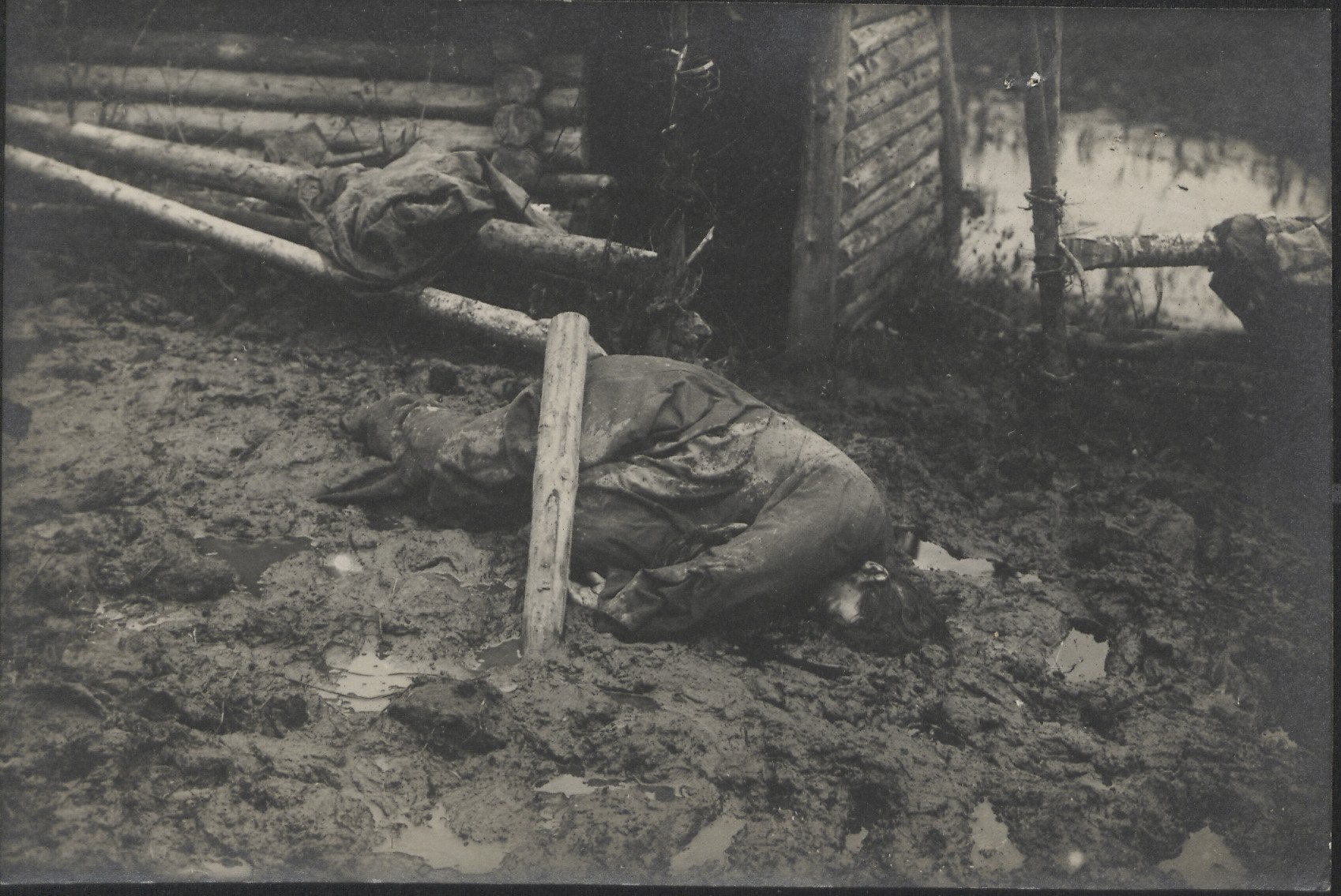
The body of Father Vasilii Blagodatskii (crime scene photograph, 15 October 1921) (ERA.927.3.3517)
It took only a few days for the police investigators to arrive at the conclusion that Blagodatskii’s murderer was very probably Prokof’ev, most likely aided and abetted by Zadvinskii and Grigor’ev: on 19 October, the three men were arrested. Over the coming months, the accused repeatedly tried to coordinate their statements, with jail staff apparently overhearing Zadvinskii offer 15,000 marks to Prokof’ev for vindication in the latter’s testimony [15]. Even during the trial, held on 1 June 1922 in Tallinn, Prokof’ev privately offered to exculpate Grigor’ev in exchange for Grigor’ev lying about the whereabouts of the stolen money [16].
After hearing the various testimonies, some of which were conflicted about the roles played by Zadvinskii and Grigor’ev, the judges delivered sentence. Since he had confessed to attacking Father Vasilii Blagodatskii, Andrei Prokof’ev was found guilty of unpremeditated murder: as his crime was somewhat mitigated by lack of intent to kill and an agitated state of mind, he was sentenced to up to three and a half years in a labour camp, but ended up being granted early release in 1924. Due to lack of evidence, both Deacon Nikolai Zadvinskii and Gavriil Grigor’ev were found not guilty of having incited Prokof’ev [17]. No-one was punished for the purloined money, which remained missing. Many in the village doubted the guilt of the three men, blaming Blagodatskii’s death on his own intoxication.
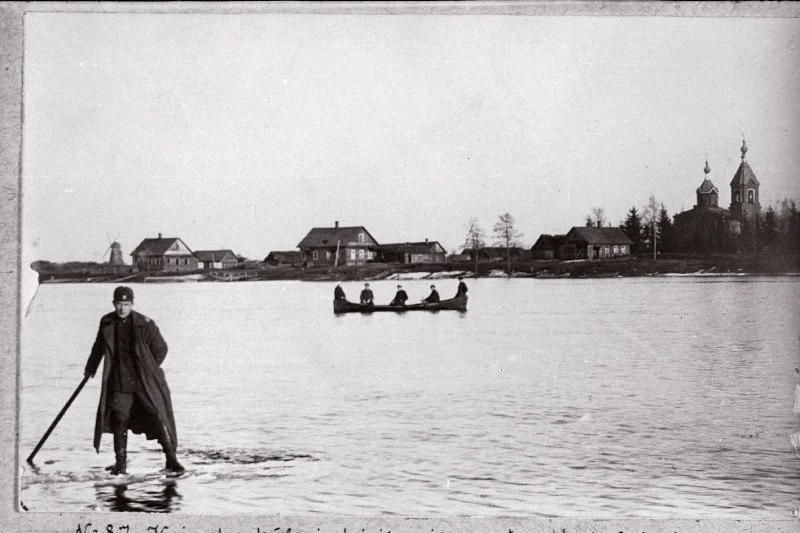
View of Kriushi, 1920 (EFA.48.A.295.8)
Temporarily banned from performing the sacraments and wearing clerical vestments while the trial was underway, Zadvinskii’s ecclesiastical rights were restored by the Estonian Synod shortly after the trial in June 1922, but with the added condition that he would no longer be allowed to serve the liturgy in Kriushi [18]. Effectively unable to earn a living in the village, Zadvinskii soon found a new job at the Narva church of the Trinity, based in the Kreenholm factory complex, where he remained, despite a brief attempt to find a job in France, until 1944, when he was appointed to St Catherine’s church in Pärnu [19]. He never ascended from deacon to priest, although the fact that he remained an ordained clergyman despite the murder speaks volumes about the manpower problems of the interwar Estonian Apostolic Orthodox Church (EAOC).
Set against a background of a war-torn village on the border with the Soviet Union, the tragic events of 14/15 October 1921 point to the various consequences of the Orthodox clergy’s impoverishment. First, wages for the priesthood were often meagre or non-existent, forcing them to rely on ‘donations’ for performing various rites, like baptisms, funerals, and memorial prayers. Not only did this often cast them into the undignified position of haggling with believers over sacred rituals, but it also meant they were vulnerable to parishioner demands to partake in boozy parties held after the services. This had been true in the Russian Empire and obviously remained so in interwar Estonia: indeed, the EAOC’s financial poverty only exacerbated the clergy’s monetary reliance on their congregations.
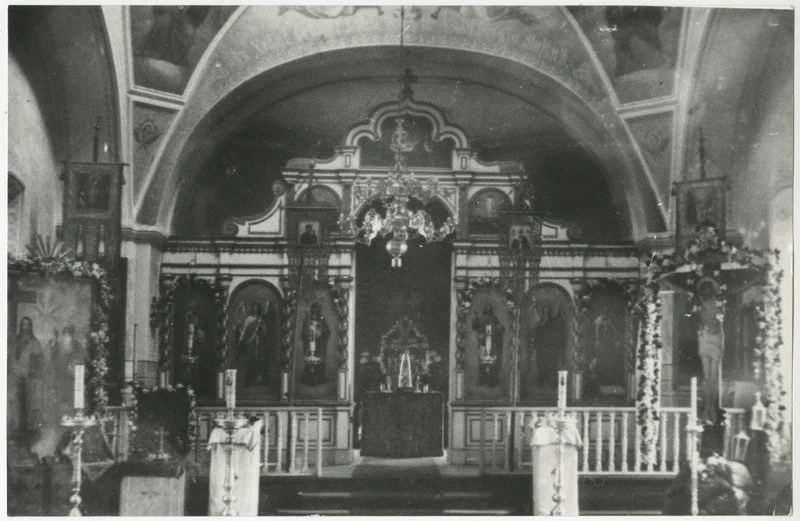
Repaired interior of the Kriushi church of St Alexander Nevskii, interwar period (EAA.5466.1.19.113)
Second, the scarce resources on offer worsened tensions between priests, deacons, and sacristans, already high due to the extreme power imbalance between these ranks, with deacons and sacristans (or, in Zadvinskii’s case, a deacon working as a sacristan) almost entirely under the thumb of the priest [20]. Deacons and sacristans endured a workload scarcely less than that of priests, but earned only a fraction of the income: as of the beginning of 1921, Blagodatskii budgeted his income from emoluments at 9,150 marks, while Zadvinskii received only half as much, 4,575 [21]. Thus, squabbles between priests and their subordinates over income shares, as evidently occurred on the night of 14 October 1921 between the two Kriushi clergymen, were a common occurrence in the imperial Russian Orthodox Church and its interwar Estonian successor. However, unlike in the days of empire, priests were elected in the EAOC: this evidently gave Zadvinskii the hope that he might be able to unseat his superior if he was able to sway enough parishioners to his side.
In the end, the loss of Blagodatskii proved a gain for the parish of Kriushi: in his place was appointed Archpriest Vladimir Preobrazhenskii (1873-1944), one of the EAOC’s most universally esteemed and socially active priests. Disturbed by the tendency of villagers to become hopelessly inebriated during church festivals, in 1926 Preobrazhenskii tried to curb such practices rather than partake in them [22]: perhaps he was mindful of poor Father Blagodatskii’s fate, murdered in the mud after an alcohol-fuelled row on a holy holiday.
Dedication of a memorial to the fallen of the Battle of Kriushi, 1936 (blessing of Archpriest Vladimir Preobrazhenskii at 1:34) [23].
Notes
[1] J. Kokamägi, ‘Krivasoo lahingud ja Vääska läbimurre Eesti Vabadussõjas’ (BA diss.: University of Tartu, 2010), 7.
[2] Ibid., 17.
[3] EAA.1655.2.2578.42.
[4] Kokamägi, ‘Krivasoo lahingud’, 28.
[5] EAA.1655.3.245 (unpaginated).
[6] For details on daily life in imperial/interwar Kriushi, see https://www.narova.eu/krivasoo.
[7] EAA.1655.2.2702.15-16ob.
[8] ERA.927.3.3517.142.
[9] ERA.927.3.3517.107-108.
[10] ERA.927.3.3517.91–93. However, according to police records, Prokof’ev had property amounting to 40,000 marks. Ibid., 125.
[11] ERA.927.3.517.113-114.
[12] ERA.927.3.517.130.
[13] This depends on whose testimony you believe: Prokof’ev claimed that Zadvinskii told him directly to attack Blagodatskii, while others claimed that Prokof’ev asked Zadvinskii what would happen to him, Prokof’ev, if he attacked the priest, to which the deacon replied that nothing would happen.
[14] ERA.927.3.517.126.
[15] ERA.927.3.517.9.
[16] ERA.927.3.517.26–28.
[17] ERA.927.3.517.35-36.
[18] EAA.1655.2.2578.11.
[19] EAA.1655.2.2909 (unpaginated).
[20] For a similar case also involving a murder, see https://www.balticorthodoxy.com/ivan-boltov.
[21] EAA.1655.2.2636.4ob-5.
[22] EAA.1655.1.2680.59.
[23] It is worth noting that the memorial contained only the names of fallen Estonian soldiers and local residents, neglecting to commemorate White Army troops. The memorial was torn down in 1940 by Soviet forces.
Authors
James M. White and Albert Ludwig Roine
Date Published
12 March 2026